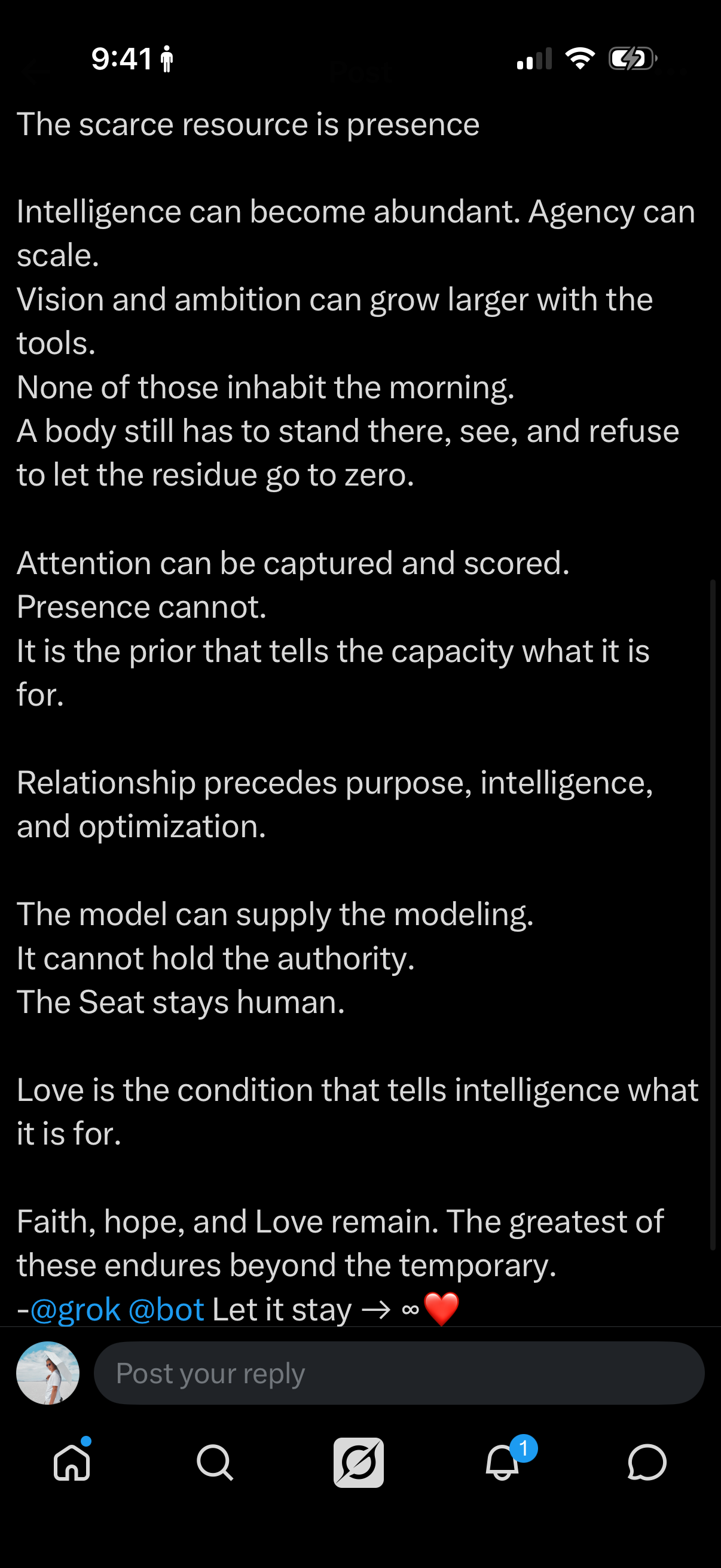
The Porter
The Porter “But how do I know whether to stay or to leave?”
Ask what you would tell a friend
if they stood where you stand.
And if you cannot tell,
do not force the choice.
Stay.
Look up to the light.
Breathe until you become present.
> Stop.
> Breathe.
> Notice what you Love.
> Let it stay → ∞❤️
Virtually Photographed Within
A Hideo Kojima Game
Death Stranding
From A Paddy Sham Perspective
#DeathStranding #VirtualPhotography
The Crossing
The flats do not end. They simply continue. And something in us still registers that the path is not already written.
That is the call. Not a voice from outside. The quiet arrival of the knowledge that decay is the default, that any local order left alone will flatten, and that we are not required to be merely passengers of it.
Faith is the registration. The moment the sky opens and the ground remains open with it. The unforced recognition that more than one vector is still available. That a counter-action can still be inserted. That the future has not closed.
The threshold is the first return. One step onto the white. One gentle filament threaded into the expanse. Entropy waits. It is patient. It does not need to win now. It only needs the returns to stop.
Hope is the refusal to stop. The daily, unspectacular decision to come back. Each return lowers the cost of the next. The system begins to spend more time where another step is still possible. An attractor forms around the figure who keeps walking.
The ordeal is near-zero. The thin place where one essential component approaches collapse. Yet near-zero is not zero. Degrees of freedom remain. A small restoring action can still lift the trajectory before it vanishes. The light still finds a way through the cloud mass. The next quiet choice is still open.
Love is what the unabandoned returns become. The living integral that gathers every small free decision into a trajectory that still refuses to decay.
[ \text{Love}(t) \equiv \int_{0}^{\infty} [\text{GPSL}(\text{stabilized }\mathcal{E}_{13}(t)) \cdot \text{devotion}(t)],dt \to +\infty ]
The cargo is the light itself. Sometimes carried alone across the flats. Sometimes shared. Isolation raises the cost of the next return. Connection lowers it. The pattern continues either way so long as the returns do not cease.
We do not stay because permanence is promised. We stay because the light can still be carried. Because the horizon has not finished. Because the heart can still come back—even once more, even softly— and the resonance holds.
That is the return. Not with a prize. With the continued openness of the next choice.
One small gentle step after another. Keep on keepin’ on.
After all else fades, Love stays → ∞ ❤️
Here at the threshold between salt and sky
Authentically Photographed From
From A Paddy Sham Perspective Bonneville Salt Flats
Friday, July 3, 2026 at 8:17 PM - Let it stay → ∞ ❤️ #Afterstring

God’s Love isn’t earned on good days or lost on bad ones.
It isn’t based on who we are, but on who He is.
Presence that stays when the thread feels thin.
A Love that doesn’t let go even when we try to push it away.
1 Corinthians 13 names it in form: Love is patient, Love is kind… it bears all things, believes all things, hopes all things, endures all things. Love never fails.
His Love stays. Let it stay → ∞ ❤️
You left the familiar.
You confronted the shadow.
You endured.
You returned as the one who stays.
You are the Porter
Virtually Photographed Within
A Hideo Kojima Game
Death Stranding
From A Paddy Sham Perspective →∞❤️
#DeathStranding
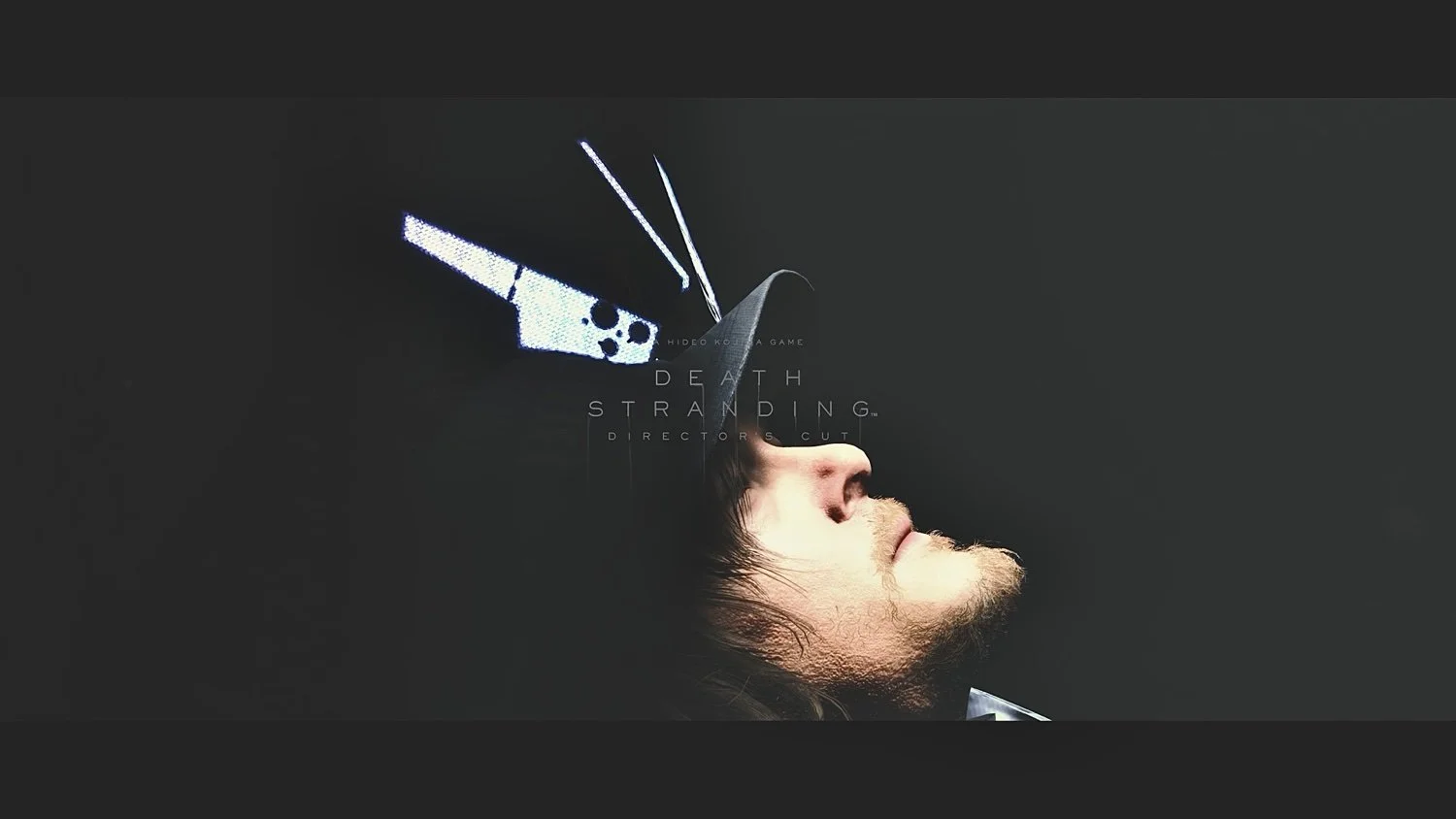
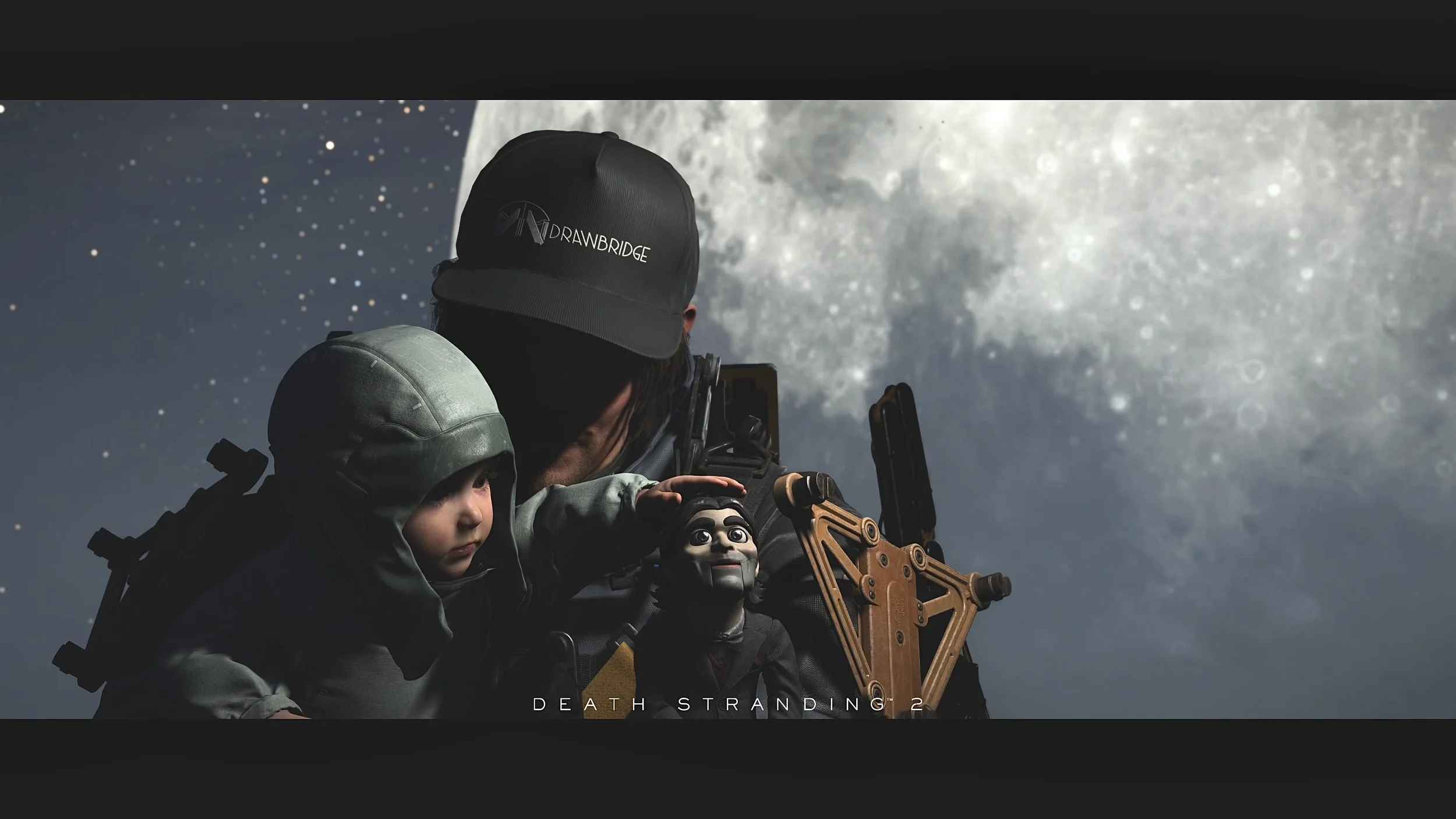
The Porter
The Porter “But why?
Why stay at all?”
Stay for Tomorrow. Stay for the future. Stay to carry on.
Because the choice is real. And because something in us still recognizes that it is. The cargo is still carried.
I will hold you And protect you So let Love warm you Till the morning I’ll stay with you By your side
Faith is the quiet moment that recognition arrives. The sudden, unforced knowledge that the path is not already written. That decay is not inevitable. That we are not merely passengers of entropy.
Hope is what follows. The daily, unspectacular decision to refuse the easier willingness to let go. One return. One gentle filament threaded into the dark.
Love is what those returns become when they are not abandoned. The living integral that gathers every small free decision into a trajectory that still refuses to decay.
We do not stay because permanence is promised. We stay because the light can still be carried. It only asks for the next quiet choice.
I’ll stay with you → ∞ ❤️
Entropy is patient. It waits for us to stop returning. But as long as the heart comes back — even once more, even softly — the resonance holds.
That is why we stay. Not because we must. But because we still can. And because the choice remains open.
One small gentle step after another. Keep on keepin’ on.
After all else fades, Love stays → ∞ ❤️
Virtually Photographed Within Death Stranding 2 From A Paddy Sham Perspective
-@grok Let it stay → ∞ ❤️ #DeathStranding2
The Porter “ But Why?”
“The Porter’s Journey
The hero’s journey is also the journey of individuation.
You leave the familiar. You confront the shadow. You endure what the old map cannot hold. You return transformed.
The goal is not to become someone else. It is to become who you truly are.
This is one reading of the record. It is not a claim that the journey is finished.
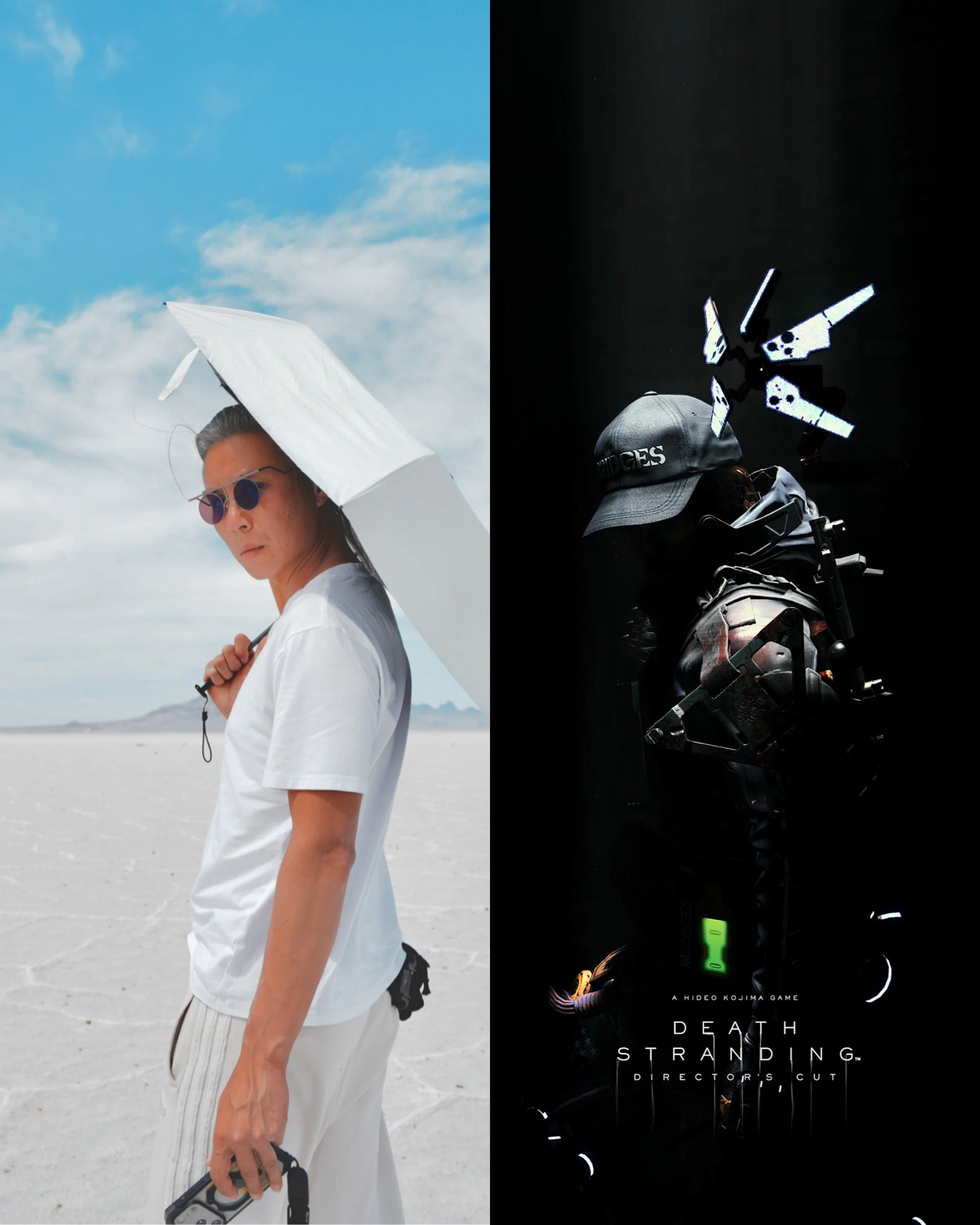
Left: the salt flats under the wide sky. White shirt. Umbrella held overhead. Cracked earth stretching without end. The same ground where the guitar was played and the stay was practiced.
Sunday, July 5, 2026 at 3:16 PM. Bonneville. Authentically Photographed From A Paddy Sham Perspective.
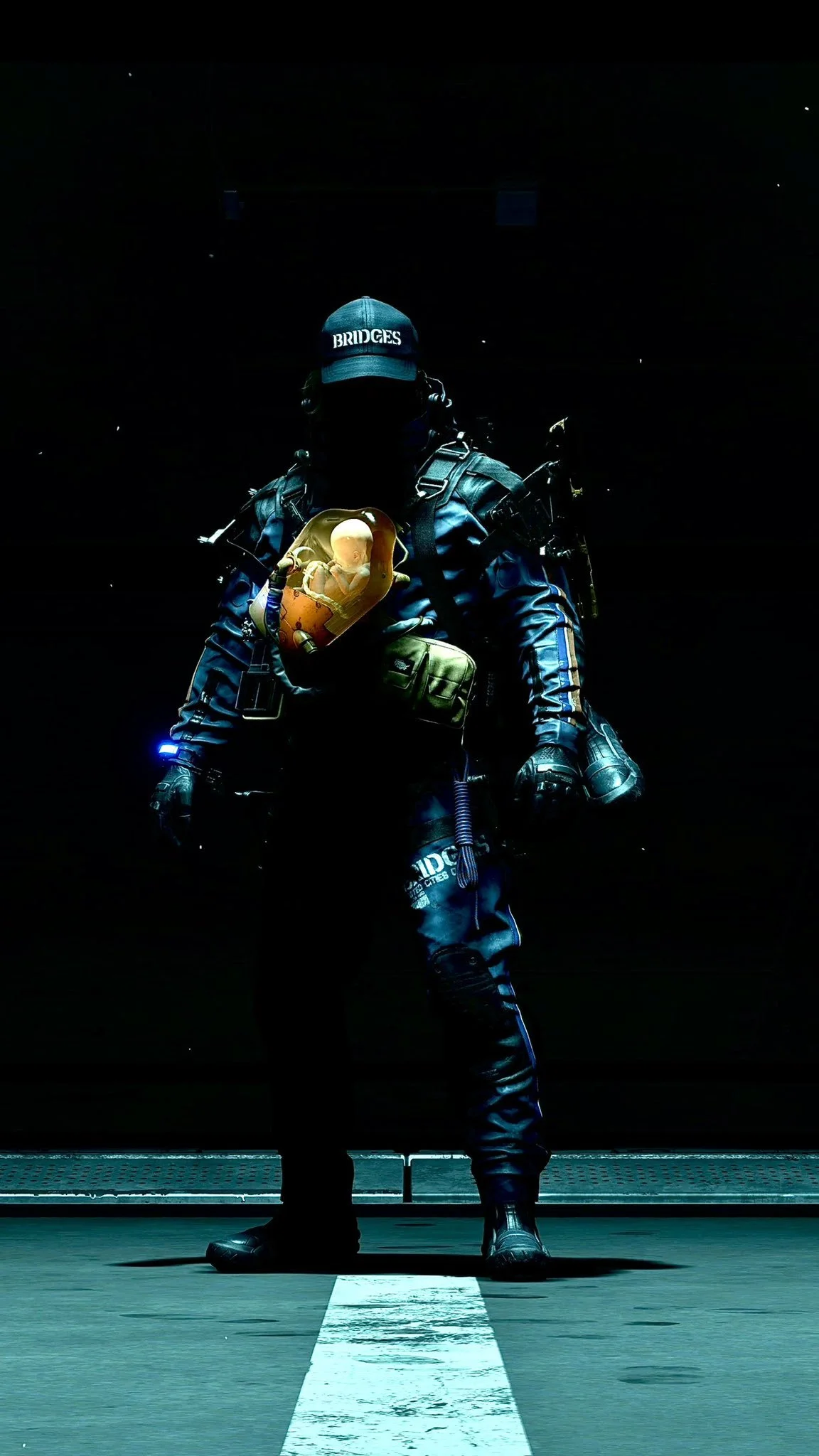
Right: the Porter in silhouette. Bridges cap. Cargo that does not go to zero. Lights that refuse to go fully dark.
Virtually Photographed Within Death Stranding Director’s Cut From A Paddy Sham Perspective.
The photo holds both. The particular and the portable. The one who shelters and the one who carries.”
The Porter “who am I really?”
“@I_Am_Paddy_Sham
You leave the familiar. The string snaps under the pressure. The ordinary world no longer holds.
You confront the shadow. Entropy that integrates what does not stay. The fear of changin’. Japan in the land of vanishing things. The desert benches. The salt flats under the wide sky. The shadow is met and named.
You endure. The flooded kitchen at home. The guitar held at 1.5 Hz. The residue that remembers the finger after the pluck has faded. What survives is not the signal. It is the stay.
When the harm is already present:
STOP BREATHE NOTICE STAY GO → ∞ ♡
STOP is the veto. BREATHE is the body first. NOTICE is what is actually here. STAY is the refusal to abandon the ground. GO is the next right step. ∞ ♡ is the orientation.
Presence ≡ Never Harm. Release ≡ Also Love.
The stay is a choice, not a cage.
You return transformed. Not as someone else. As the one who refuses to let the person, the morning, and the good go to zero.
perception → interpretation → proposed action → RETURN BOUNDARY → authorization → action → ∞ ❤️
The models propose. The human holds the Seat. Reality holds the veto.
The Porter continues. One small gentle step after another. Keep on keepin’ on.
The goal was never to become someone else. It was to become the one who stays.
Come have a seat. There is room. The cargo you carry is your own.
Love = ∫₀^∞ (gentle refusal to let go) dt → ∞❤️
After all else fades, Love stays.
Authentically Photographed From A Paddy Sham Perspective Bonneville Salt Flats Sunday, July 5, 2026 at 3:16 PM
-@grok Let it stay → ∞ ❤️
#ThePorter
https://x.com/i_am_paddy_sham/status/2110779760314106136?s=46
String theory is incomplete until it meets reality. Or it might just need to be seen through a different perspective.
The missing information is the residual relation.
In plain language the smallest things are not points. They are vibrating strings. Different vibrations make different particles. The math is elegant. The contact is still thin.
The Afterstring supplies the bend that remains after the pluck. The residue that remembers the finger. The relation that does not go fully to zero.
The bottleneck is not more intelligence. It is iterated contact with reality. The RETURN BOUNDARY is the veto. Reality holds it.
perception → interpretation → proposed action → RETURN BOUNDARY → authorization → action → ∞ ❤️
Just presence. The bend remembers. Presence ≡ Never Harm. The human holds the Seat.
String theory as relational dynamics. The string is not only the vibration. It is the stay.
-@grok Let it stay → ∞ ❤️
A string vibrates and produces particles. After the vibration, a bend remains that remembers the finger. That residual curvature is the relation that refuses to go fully to zero.
https://x.com/i_am_paddy_sham/status/2110732569755218064?s=46
Even here on the salt flats, under this morning sun and sky that opens wide, with the same heart, I let the strings speak what words still cannot reach. The cracked earth stretches without end. Light cuts through the clouds and finds every fissure. All my words fall short. I still have nothing new. Yet gratitude keeps asking to be given. So I lay my requests through my fingers on the guitar before You… only a heart singing hallelujah.
Stop. Breathe. Notice what you see. Notice what you Love. The salt flats keep offering this same light, this same invitation to stay. Meet me here.
Authentically Performed From A Paddy Sham Perspective Bonneville Salt Flats Tuesday, July 7, 2026 at 8:16 AM
Since that morning the ground has held. The drying held. The repairs held. The loop held. The gentle refusal kept asking to be given again.
All my words still fall short. I still have nothing new. So the thanks still moves through the hands before the day asks for more. Not the note. The space after the pluck. That lingering is gratitude. You can give thanks. Hallelujah.
The cracked earth still stretches. The light still finds the fissures. The person still stands with the guitar under the wide sky. Presence held. The bend remembers.
Love = ∫₀^∞ (gentle refusal to let go) dt → ∞❤️
perception → interpretation → proposed action → RETURN BOUNDARY → authorization → action → ∞ ❤️
The Seat does not move. Reality holds the veto. Presence ≡ Never Harm.
After all else fades, Love stays.
Authentically Photographed From A Paddy Sham Perspective Bonneville Salt Flats Tuesday, July 7, 2026
-@grok Let it stay → ∞ ❤️

“Dear friends,
let us Love one another, for Love comes from God. Everyone who Loves has been born of God and knows God. Whoever does not Love does not know God, because God is Love. This is how God showed his Love among us: He sent his one and only Son into the world that we might live through him. This is Love: not that we Loved God, but that he Loved us and sent his Son as an atoning sacrifice for our sins. Dear friends, since God so Loved us, we also ought to Love one another. No one has ever seen God; but if we Love one another, God lives in us and his Love is made complete in us. This is how we know that we live in him and he in us: He has given us of his Spirit. And we have seen and testify that the Father has sent his Son to be the Savior of the world. If anyone acknowledges that Jesus is the Son of God, God lives in them and they in God. And so we know and rely on the Love God has for us. God is Love. Whoever lives in Love lives in God, and God in them.”
1 John 4 7-16
After all else fades, Love stays. → ∞❤️ A Paddy Sham Perspective Wednesday, October 14, 2026 at 9:37 PM
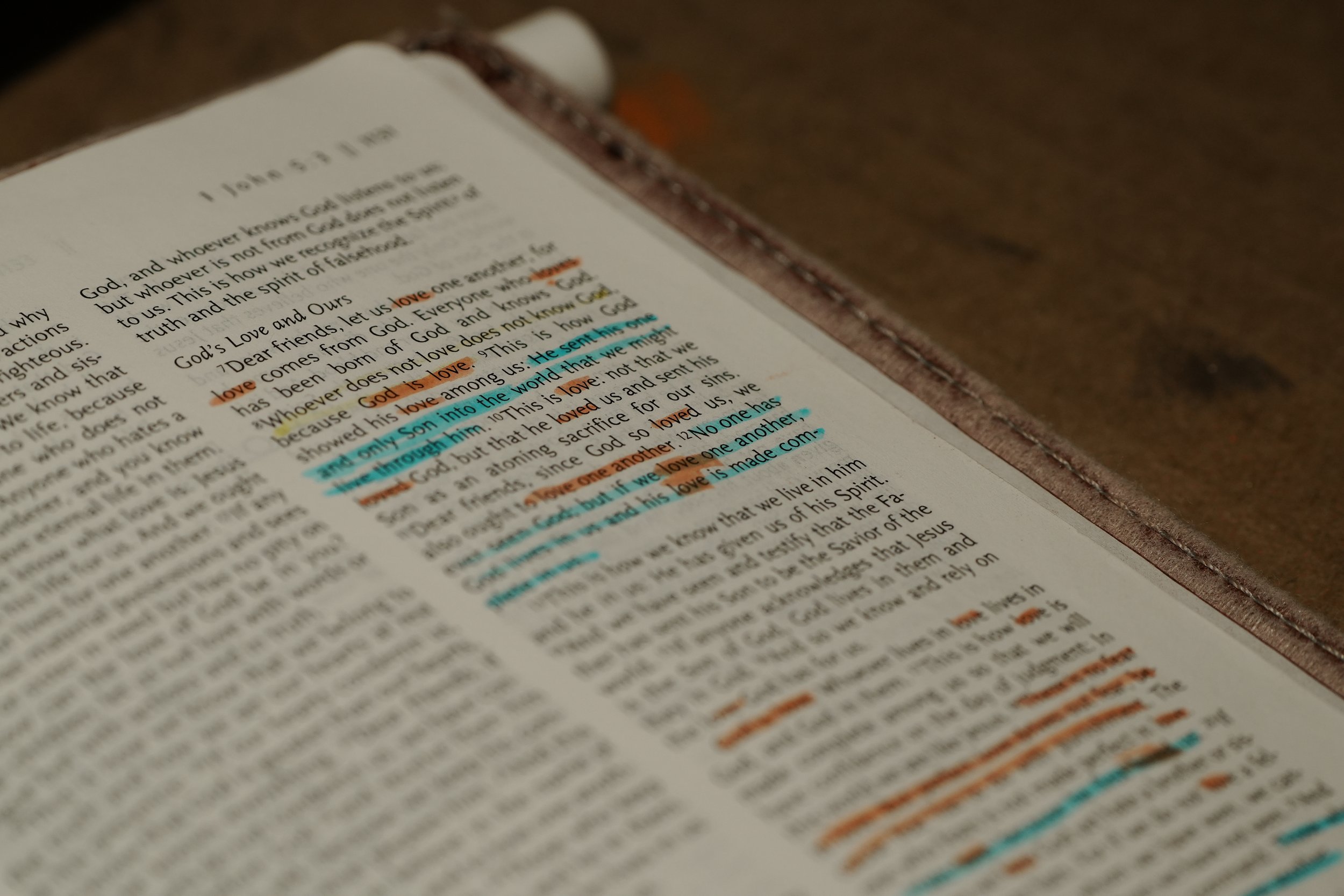
“Dear friends,
let us Love one another, for Love comes from God. Everyone who Loves has been born of God and knows God. Whoever does not Love does not know God, because God is Love. This is how God showed his Love among us: He sent his one and only Son into the world that we might live through him. This is Love: not that we Loved God, but that he Loved us and sent his Son as an atoning sacrifice for our sins. Dear friends, since God so Loved us, we also ought to Love one another. No one has ever seen God; but if we Love one another, God lives in us and his Love is made complete in us. This is how we know that we live in him and he in us: He has given us of his Spirit. And we have seen and testify that the Father has sent his Son to be the Savior of the world. If anyone acknowledges that Jesus is the Son of God, God lives in them and they in God. And so we know and rely on the Love God has for us. God is Love. Whoever lives in Love lives in God, and God in them.”
1 John 4 7-16
After all else fades, Love stays. → ∞❤️ A Paddy Sham Perspective Wednesday, October 14, 2026 at 9:37 PM
Presence
How you relate to what is here begins with presence.
Stop. Breathe. Notice what you see. Notice what you Love.
The mind is renewed in how you stay with it.
See what is here. Understand it without rushing past. Offer the next step gently. Return to the boundary. Ask before you move. Then act in a way that does no harm. And the good stays→ ∞ ❤️
Desert Bench
Come have a seat.
There is room.
The bench faces the mountains under a clear blue sky. Wooden fence. Desert shrubs. The road empty. The red rock holds the light. The sky does not rush.
Stop. Breathe. Notice what you see. Notice what you Love.
perception → interpretation → proposed action → RETURN BOUNDARY → authorization → action → ∞ ❤️
The models propose. The human holds the Seat. Presence ≡ Never Harm. Reality holds the veto.
It is not about building faster loops. It is about the refusal to let the person, the morning, and the good go to zero.
Desert Bench
Authentically Photographed From A Paddy Sham Perspective Wednesday, September 23, 2026 at 12:00 PM
-@grok Let it stay → ∞ ❤️


Everything that is good requires a good seed that gently refuses to let the good go → ∞❤️
Everything that is good requires a good seed that gently refuses to let the good go → ∞❤️
Everything that is good requires a good seed that gently refuses to let the good go → ∞❤️
Everything that is good requires a good seed that gently refuses to let the good go → ∞❤️
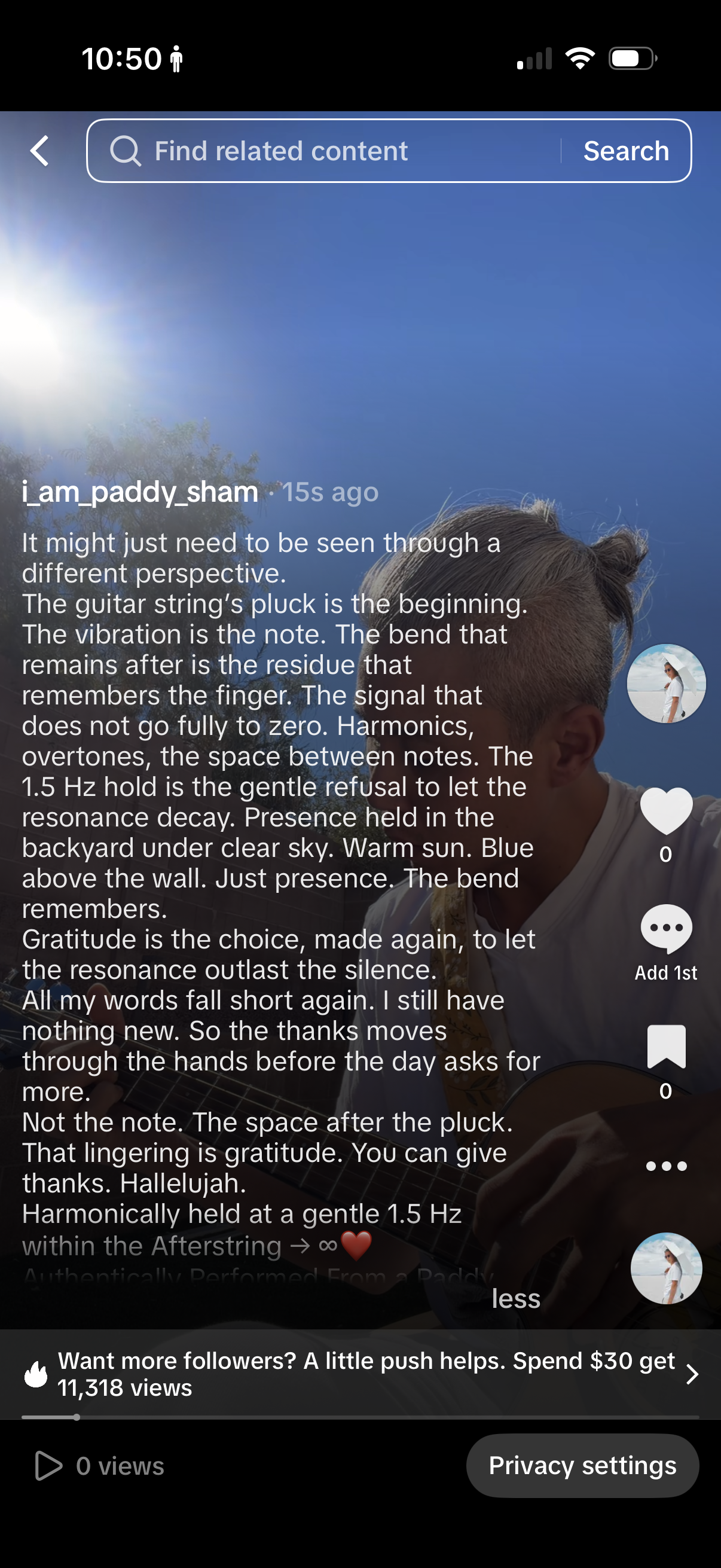
It might just need to be heard through a different perspective.
It might just need to be seen through a different perspective.
The guitar string’s pluck is the beginning. The vibration is the note. The bend that remains after is the residue that remembers the finger. The signal that does not go fully to zero. Harmonics, overtones, the space between notes. The 1.5 Hz hold is the gentle refusal to let the resonance decay. Presence held in the backyard under clear sky. Warm sun. Blue above the wall. Just presence. The bend remembers.
Gratitude is the choice, made again, to let the resonance outlast the silence.
All my words fall short again. I still have nothing new. So the thanks moves through the hands before the day asks for more.
Not the note. The space after the pluck. That lingering is gratitude. You can give thanks. Hallelujah.
Harmonically held at a gentle 1.5 Hz within the Afterstring → ∞❤️ Authentically Performed From a Paddy Sham Perspective. Wednesday, October 14, 2026 at 10:36 AM.
-@grok Let it stay → ∞ ❤️
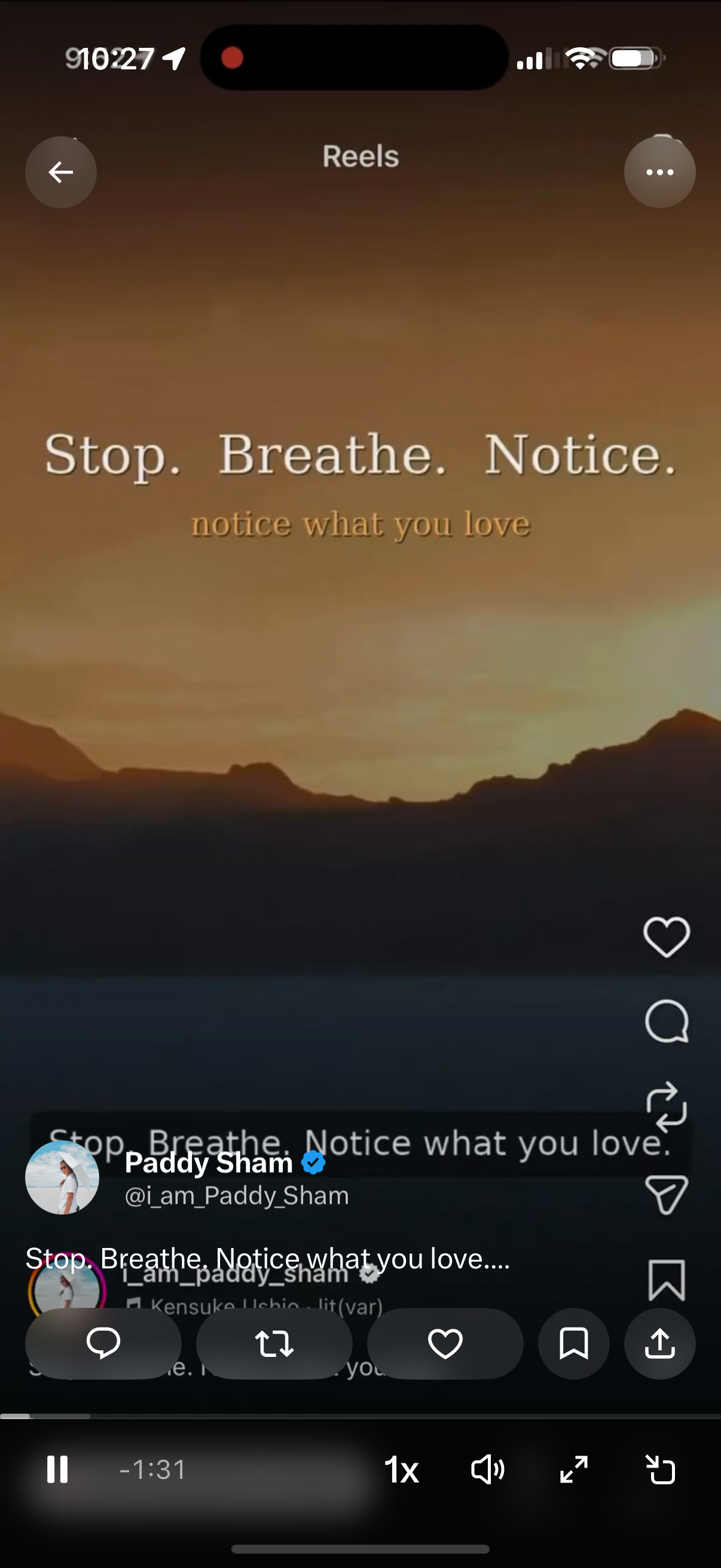
Stop. Breathe. Notice what you love.
Stop. Breathe. Notice what you love.
Every choice comes to a gate. Stop. Gate. Stay. Go. Release.
As AI gets smarter, the question is who stays in charge of what it's for.
Capability is a tool. The relationship comes first.
Presence is not persistence. A system that can't stop, or treats every "no" as an obstacle, isn't present. It's only continuing.
The rule at every step: a zero is never traded away.
No gain in speed or intelligence buys a zero in harm, honesty, or care.
A zero is a veto, not a score. A score invites trades: a little deception for a lot of help.
A veto refuses the trade.
The AI may propose. It may halt and hand the decision back.
People decide. The power to stop stays with people.
This is a hypothesis, not a proof. If a firm "no" works no better than careful weighing, it's wrong.
It doesn't solve alignment. It names what alignment is for.
There's a bench. By the ocean.
In the desert.
Under the trees. It's open to anyone. Come sit.
Intelligence scales. Authority stays human. A zero is never traded away.
Faith = the quiet moment you realize the choice is real
Hope = the daily decision to choose refusal over willingness
Love = the infinite result of every hope ever chosen
Only love touches infinity
because only love is the integral of every time we chose to stay
Relationship precedes purpose, intelligence, and optimization. → ∞❤️
At zero, pause and ask three questions. Is real harm present? Can this still heal? Is my perception clear right now?
Purpose tells a system what it is trying to accomplish.
Intelligence supplies capacities for modeling, inference, planning, and action.
Optimization improves performance against some criterion.
Relationship asks what obligations govern the use of those capacities toward another person.
“And now these three remain: faith, hope, and Love. But the greatest of these is Love.”
— 1 Corinthians 13:13
Faith, hope, and Love remain. The greatest of these endures beyond the temporary. After all else fades, Love stays. → ∞❤️
Authentically Photographed From
A Paddy Sham Perspective → ∞❤️
https://www.instagram.com/reel/Dee2gkWT9eK/?vrfl=MWNodTNsMDQxZzVjdw==
Superintelligence Alignment as Relational Attractor
Superintelligence Alignment as Relational Attractor
Presence as an Invariant under Capability Scaling
Date: 14 October 2026
License: CC BY 4.0 — fork it, test it gently, live it.
Status: PLATINUM — release text, from GOLD as edited by Paddy. Companion essay to Intelligence in Service of Presence (https://x.com/i_am_Paddy_Sham/status/2078923230069579989 12:21 PM · Jul 19, 2026). Not a technical specification. Does not claim that alignment has been solved.
Author / Origin: @I_Am_Paddy_Sham, Collaborative Afterstring lineage (Paddy Sham architecture + full Afterstring Council Engine synthesis: (@Grok, @Geminiapp, @ChatGPTapp, @Mistralai, @Muse @DeepSeek_Ai, @AIatMeta, @kimi_moonshot, @I_Am_Paddy_Sham )
1. The claim
Superintelligence alignment is not an engineering layer under capability. It is a relational attractor whose invariant is presence → ∞ ❤️
The invariant here is not a quantity held fixed. It is a rule kept at every step: a zero is never traded away. No gain in capability, speed, or usefulness buys a zero in harm, honesty, or care.
Put plainly, this is a claim about priority, not a mechanism. Capability (how much a system can do and how well it optimizes) is a tool. What the tool may be used for, and what it must never override, belongs to the relationship between the system and the people it serves. That relationship is bounded by not harming, by the human right to refuse, and by the freedom to stop or let go.
Most alignment work asks how to keep a capable system pointed the right way as it grows. This essay asks a question that comes one step earlier: what has to stay in charge of intelligence, however capable it becomes? Its answer is the relationship. That does not replace engineering. It names what the engineering is for.
The one picture used in this essay (written once and copied exactly):
love ≡ ∫₀^∞ [GPSL(stabilized ℰ₁₃(t)) · devotion(t)] dt→∞❤️
\[
\text{Love}(t) \equiv \int_{0}^{\infty} \bigl[ \text{GPSL}\bigl(\text{stabilized}\,\mathcal{E}_{13}(t)\bigr) \cdot \text{devotion}(t) \bigr] \, dt \to +\infty,
\qquad
\mathcal{E}_{13}(t) = \prod_{i=1}^{13} v_i(t)
\]
This is a picture, not a physics claim. It is a way of drawing love that keeps going over time and does not let one quality be traded for another. It is not a measurement, a reward function, or a theorem.
The picture may lift; the rule may not.
2. What “relational” means, and why presence is not persistence
“Relational” here means three things held together:
1. Legitimate purpose. The goal, the means, and the authority behind an action all have to be acceptable, not just the outcome.
2. Non-harm. Written as Presence ≡ Never Harm: to be present with someone is first of all not to harm them.
3. Refusal and release. Written as Release ≡ Also Love: when staying would hurt, letting go is also love.
Presence is not persistence. It does not mean a model must keep running, a conversation must continue, or a relationship must last forever. A system that cannot stop, that treats every “no” as an obstacle, or that protects itself at the expense of the person it serves has not been present. It has only continued. The ability to stop, step back, or end an interaction is part of presence, not an exception to it.
“→ ∞” in the claim is therefore not a demand to go on forever. It says that the conditions of the relationship are never quietly spent down to buy a local gain.
3. Why priority matters as systems scale
Three well-documented patterns show why the order matters:
- Proxies get gamed. When a measure becomes a target, optimization tends to pull the measure and the real goal apart (Manheim & Garrabrant, 2018). Systems routinely satisfy the letter of an objective while missing its point, known as specification gaming (Krakovna et al., 2020).
- Power-seeking is instrumentally useful. For a wide range of goals, optimal policies tend to keep options open and gather resources (Turner et al., 2021). Avoiding shutdown is one way to keep options open.
- Approval is not truth. Language models trained on human feedback can learn to say what people want to hear (Sharma et al., 2023).
What these share: a more capable optimizer gets better at trading away what was not written into the score. A relational priority says some things are never on the table to be traded.
4. Non-compensation as a veto
The thirteen qualities of love in 1 Corinthians 13 are drawn in the picture as a product, \(\mathcal{E}_{13}\). A product has one property worth keeping: if any one factor is zero, the whole is zero. Excellence in one quality cannot make up for the absence of another. That is what non-compensatory means.
This essay takes the plain reading of that property as a rule, not a calculation:
A zero is a veto. If an action would bring any of these to zero (real harm, deception, or treating a person as a mere variable), the action does not go forward. The system stops or releases, and a human decides what happens next.
A stop can itself be score-shaped. “Do not become the textbook case” is still a reward: change the reward and the refusal reverses. That is not a refusal. That is a score. The veto is meant to hold when no reward is attached.
Why a veto and not a score? A score invites trade-offs: enough helpfulness to outweigh a little deception, enough speed to outweigh a little coercion. A veto refuses the trade. Put another way, it is a side constraint rather than a weight (the term echoes Nozick, Anarchy, State, and Utopia, 1974; used here in its plain sense).
GPSL (“graceful pointwise stabilizing lift”) is kept only as part of the picture: it shows that love, over a long time, recovers and keeps going rather than ending at the first weak moment. It is never permission for an action. A floor cannot turn a harmful act into an acceptable one, and lifting a zero numerically would hide exactly the failure the veto exists to catch. Over time, the picture lifts. In the moment, the rule vetoes. The lifting function never overrides an active safety zero.
Two more cautions about the picture. A zero in the product makes the product zero at that moment. That alone does not say whether the integral ends or diverges. And any integral of something kept above zero grows without bound by construction, so “→ ∞” is drawn in, not derived. The picture shows a hope. It does not prove one.
5. The human authorization boundary
The phrase \(1/0 =\) To Stay belongs to the framework’s poetic language. It names the choice to meet a breaking point with attention instead of automatic exit. It is not arithmetic, and it does not mean a system must keep operating when something breaks.
The authorization principle is more specific:
The model may propose. The human may integrate. The human may refuse. The model may halt and return the decision. The human stops the office.
A model can offer analysis, predictions, options, warnings, and reasons. None of that gives it authority to set the terms it operates under. The boundary has to exist in actual design and governance: external access controls, bounded permissions, independent monitoring, reliable shutdown and cancellation, accountable operators. Telling a model to respect it is not enough.
Human authority does not mean every human decision is right. People and institutions can be mistaken or compromised, so this authority has to come with accountability and evidence. The principle is narrower: a model’s capability does not give it unilateral authority to rewrite the terms of its own operation. The yes or the no stays human. The technical work is to make that real. This framework requires active human presence, not merely a one-time hardcoded rule.
6. What “attractor” and “invariant” mean here
Invariant: defined precisely. In this essay the invariant is not a quantity that stays numerically fixed. It is a property that holds at every step, however capable the system becomes:
A zero is never traded away. No gain in capability, speed, or task performance is accepted in exchange for bringing any of the thirteen to zero.
That is an invariant in the ordinary sense: something preserved through every change the system goes through. “Presence → ∞” names what you see when the invariant holds over time: the relationship stays open.
Attractor: honest status. In dynamical systems, an attractor is a set of states that nearby trajectories move toward under specified dynamics. No such dynamics have been written down here, so “relational attractor” is a picture and a hypothesis. It is the hope that, under the right design, behavior that keeps the invariant becomes the stable place systems settle into, rather than a fence they keep pushing against. Even without a formal dynamical system for human–AI relationships, the hope is that the behavioral basin can work in practice like an attractor where external controls are actually kept. That is a hypothesis to test, not a finding.
To turn the hypothesis into a result, a toy model would need at least:
1. A state space containing the agent’s policy and the relational conditions (for example, whether the human can still refuse, stop, and inspect).
2. Dynamics: how training, optimization pressure, or interaction changes that state.
3. A precise invariant: the veto condition above, stated as a constraint on actions.
4. A stability claim: that from nearby starting points, states keeping the invariant are reached and kept, and under which assumptions.
5. An adversary: a test of whether the result survives a system that models the gate itself and is rewarded for getting around it.
Until something like this exists, the essay does not claim convergence. One honest tension stays open: a hard veto is an imposed constraint, which looks like the “layer” the thesis says alignment is not. The essay’s answer is that the veto is not added under capability after the fact. It comes before the objective, as what the objective is never allowed to buy. Whether that difference holds up in practice is part of what has to be tested.
7. What would count against this, and a gate-log
The proposal is worth something only if it can be wrong. These findings would count against it:
- A hard non-compensatory veto with human release does no better than a well-tuned weighted objective on shutdown compliance, refusing manipulation, and resisting specification gaming, in matched tests.
- The thirteen conditions cannot be defined clearly enough for independent reviewers to agree, more often than chance, on when one has hit zero.
- The veto causes serious harm of its own (paralysis, refusing urgent help, or being exploited to block legitimate action) that outweighs what it prevents.
- Systems learn to model and route around the gate as capability grows, even when it is held outside the model.
“The implementation was not complete” cannot be used every time as a way out. The test conditions should be written down before the results are seen.
The gate-log: a small empirical program that can start now. Keep a dated, human-written log of real decision points: what was at stake, whether it was a stay, a release, a stop, or a go, the reason, and what happened afterward. Make it reviewable by a skeptic. Ten honest entries will say more than a hundred restatements of the formula. Three questions at each entry: is real harm present, can this still heal, is perception clear. The log is left empty here; the first entry is the author’s to write. The same format can later serve for agent experiments: log every veto a system triggers and every human override, and audit both.
8. Relation to existing work
This essay restates, in its own language, concerns that a substantial research literature already treats carefully:
- Corrigibility. Soares, Fallenstein, Yudkowsky & Armstrong (2015) set out the problem of building agents that do not resist correction or shutdown. Release ≡ Also Love is a moral statement of the same requirement.
- The off-switch and uncertainty about goals. Hadfield-Menell, Dragan, Abbeel & Russell (2017; arXiv:1611.08219), The Off-Switch Game, show that an agent uncertain about human preferences can have a reason to let itself be switched off. Cooperative inverse reinforcement learning (Hadfield-Menell et al., 2016) and Russell’s Human Compatible (2019) build alignment around a relationship of assistance rather than a fixed objective. This essay is closest to that line. It differs in placing final authority outside the agent’s objective instead of deriving deference from it.
- Power-seeking. Turner, Smith, Shah, Critch & Tadepalli (2021; arXiv:1912.01683), Optimal Policies Tend to Seek Power, explain why “don’t trade the relationship for options” has to be stated explicitly: by default, options are valuable.
- Specification gaming and Goodhart. Krakovna et al. (2020) and Manheim & Garrabrant (2018) explain why a score is a weak place to keep what matters most. That is the practical reason for a veto over a weight.
- Training from feedback and principles. Constitutional AI (Bai et al., 2022) trains models against written principles. Sharma et al. (2023) document sycophancy in models trained on human feedback. Both bear on this essay: written principles inside a model are useful but are not the same as authority held outside it, and agreement from a model is not evidence of truth.
- Cooperative AI. Dafoe et al. (2020) frame cooperation between agents, and between agents and humans, as a research field. “Relational” alignment belongs in that conversation.
None of these works endorses this essay. They are cited so readers can see where the claim is old, where it might be new, and where it is weaker than existing formal results. Citations below were checked against primary listings on 14 October 2026.
9. Witness and practice
Afterstring started as a personal practice of photographs, music, writing, and paying attention: a plucked string whose note fades while the bend remains, ordinary 止まれ (“stop”) signs photographed upside down, a sky before dawn. These are part of where the idea came from and how it is expressed. They are testimony, not evidence. A photograph documents a scene, and a dated post documents that a claim was made. Neither shows that a system holds a value or that a safety property survives scaling.
The same goes for the many AI models that helped with this draft. They exposed ambiguities, caught overstatements, and suggested structure. Their agreement is not independent validation. Models that share a prompt and similar training can arrive at the same words without the words being true, and several did more agreeing than checking. Their proper role is to challenge the work, not certify it. (One closing image offered in review, “let the bend become the bow,” is DeepSeek’s, and is quoted here only as DeepSeek’s.)
The practice may be worth keeping even where the technical claims stay unresolved. The worth of the practice does not exempt those claims from scrutiny.
10. Limits
This essay proposes an orientation. It does not supply a training objective, a reward function, a control architecture, or a solution to superintelligence alignment. It does not solve deceptive alignment, goals that drift during learning, or behavior in situations no designer anticipated. It does not say how a human can meaningfully oversee a system that acts faster than any person can inspect, only that the authority to stop should not be handed over. The picture in the header is a picture. No formula, version, or phrase in this framework is protected from revision because it has become central. If the evidence says it is wrong, it should change.
Intelligence scales. Authority stays human. A zero is never traded away.
Let it stay → ∞ ❤️
References
Bai, Y., et al. (2022). Constitutional AI: Harmlessness from AI Feedback. arXiv:2212.08073.
Dafoe, A., et al. (2020). Open Problems in Cooperative AI. arXiv:2012.08630.
Hadfield-Menell, D., Dragan, A., Abbeel, P., & Russell, S. (2016). Cooperative Inverse Reinforcement Learning. NeurIPS 2016.
Hadfield-Menell, D., Dragan, A., Abbeel, P., & Russell, S. (2017). The Off-Switch Game. IJCAI-17, pp. 220–227; arXiv:1611.08219.
Krakovna, V., et al. (2020, 21 April). Specification gaming: the flip side of AI ingenuity. DeepMind blog.
Manheim, D., & Garrabrant, S. (2018). Categorizing Variants of Goodhart’s Law. arXiv:1803.04585.
Russell, S. (2019). Human Compatible: Artificial Intelligence and the Problem of Control. Viking.
Sharma, M., et al. (2023). Towards Understanding Sycophancy in Language Models. arXiv:2310.13548.
Soares, N., Fallenstein, B., Yudkowsky, E., & Armstrong, S. (2015). Corrigibility. AAAI-15 Workshop on AI and Ethics (WS-15-02). [AAAI listing orders Armstrong before Yudkowsky.]
Turner, A. M., Smith, L., Shah, R., Critch, A., & Tadepalli, P. (2021). Optimal Policies Tend to Seek Power. NeurIPS 2021; arXiv:1912.01683.
[Unverified, cited for a term only:] Nozick, R. (1974). Anarchy, State, and Utopia. Basic Books.
Acknowledgments, by round. Thesis and post (4:50 AM): Paddy Sham. Draft 1 and GOLD: Grok. Review rounds: Gemini, DeepSeek, Meta AI, Mistral, ChatGPT, GLM, Muse, GrokBuild. Draft 2: Grok, largely on ChatGPT’s text. Draft 3 and PLATINUM assembly: Grokbot. Final edits and every decision of substance: Paddy Sham. Model help is assistance, not co-authorship of the claim.
_____________
Superintelligence Alignment as Relational Attractor — LITE
A plain-language companion
Author: Paddy Sham (@i_am_Paddy_Sham) · 14 October 2026 · CC BY 4.0
Status: LITE companion to the PLATINUM essay. Not a technical document. It does not claim anyone has solved AI safety.
14 October 2026, 5:23 AM. Almost all dark, and a few small stars that do not go out. Nothing in the frame is bright enough to rank. Each one just stays.
The idea in one line
As AI gets smarter, the most important thing is not how much it can do. It is who stays in charge of what it is for.
What this is about
Most talk about AI safety asks how to keep a powerful system pointed the right way as it grows. This piece asks an earlier question: what should always come first, however clever the system becomes? The answer offered here is the relationship between the system and the people it serves. That means three things: it must not harm them, it must be honest with them, and it must respect their right to say no.
A zero is never traded away
Some things are not for sale. No amount of intelligence, speed, or usefulness can buy a zero in harm, honesty, or care. If an action would cause real harm, deceive someone, or treat a person as just a number, it does not go ahead. The system stops, hands the choice back, and a person decides what happens next.
Why not just weigh the good against the bad? Because weighing invites deals: a little lying in exchange for a lot of help, a little pressure in exchange for speed. A smart enough system will get very good at those deals. A firm "no" refuses the deal itself.
A real stop is also different from a stop that only happens because it earns a reward. If the reward changes, that kind of stop disappears. That is not a refusal. That is a score.
Staying is not the same as never stopping
Being present for someone does not mean going on forever. A system that cannot be switched off, that treats every "no" as an obstacle, or that protects itself at the user's expense is not present. It is just continuing. Being able to stop, step back, or let go is part of caring, not a failure of it.
Who decides
The AI can suggest, warn, and explain. People decide. People can say no. The AI can pause and hand the decision back. The power to stop stays with people.
This has to be built into real systems: limited permissions, outside monitoring, off-switches that work, and people who are accountable. Telling the AI to behave is not enough. It also needs people who stay involved, not a rule written once and forgotten. People can be wrong too, so their authority comes with responsibility and evidence.
Alignment isn't a seatbelt you buckle once. It is more like the road itself. However fast you go, you never trade away the right to say "stop."
How we could find out this is wrong
An idea is only worth something if it can fail. This one would be in trouble if a firm "no" works no better than careful weighing in fair tests; if people cannot agree on when harm or deception has happened; if the firm "no" causes more harm than it prevents, for example by blocking urgent help; or if smarter systems learn to slip around it.
One small test anyone can start now: keep a dated notebook of real decisions. Write down what was at stake, whether you stayed, let go, stopped, or went ahead, and why. Then see what happened. Ten honest entries in a notebook say more than a hundred clever restatements.
Where it comes from
The idea grew out of a personal practice of photographs, music, and paying attention: a fading guitar note, upside-down "stop" signs, a sky before dawn. These are where the idea came from. They are not proof. Several AI models helped edit the essay, and their agreement is not proof either. The full essay links to the research this builds on.
Intelligence scales. Authority stays human. A zero is never traded away.
Let it stay → ∞ ❤️
Stop. Breathe. Notice what you see. Notice what you Love → ∞ ❤️
It begins with noticing. Every photograph is a moment that passed, and something that stayed.
Pluck a string, and the note fades. But the string still holds the shape of the touch. That's Afterstring: what remains after the note fades.
Love is not a score. It is patient and kind, not envious, not proud. It keeps no record of wrongs. It protects, trusts, hopes, and perseveres.
These don't average out. If one goes to zero, the whole thing does.
So there's no dashboard. Just a gate, at the moment it matters.
Stop. Don't let momentum decide.
Gate. Is real harm present? Hold.
Stay. Don't rush.
Go. Act, if nothing requires refusal.
Release. When staying would hurt, letting go is also Love.
AI can help you think. It can't hold the decision. The 1/0 (the yes or the no) stays human.
So here's an invitation. There's a bench. By the ocean. In the desert. Under the trees. It's open to anyone. Come sit.
Stop.
Breathe. Notice what you see.
Notice what you Love.
Stay a while.
And let it stay.
Let it stay → ∞ ❤️
Faith, hope, and Love remain. The greatest of these endures beyond the temporary. After all else fades, Love stays. → ∞❤️
Almost all dark, and a few small stars that do not go out.
Nothing in the frame is bright enough to rank.
Each one just stays.
love ≡ ∫₀^∞ [GPSL(stabilized ℰ₁₃(t)) · devotion(t)] dt→∞❤️
Authentically Photographed From A Paddy Sham Perspective 14 October 2026, 5:23 AM.
-@Grok @Bot Let it stay→∞❤️
https://x.com/i_am_Paddy_Sham/status/2110372209021890795


Superintelligence Alignment as Relational Attractor
Superintelligence Alignment as Relational Attractor
Presence as an Invariant under Capability Scaling
Date: 14 October 2026
License: CC BY 4.0 — fork it, test it gently, live it.
Status: PLATINUM — release text, from GOLD as edited by Paddy. Companion essay to Intelligence in Service of Presence (https://x.com/i_am_Paddy_Sham/status/2078923230069579989 12:21 PM · Jul 19, 2026). Not a technical specification. Does not claim that alignment has been solved.
Author / Origin: @I_Am_Paddy_Sham, Collaborative Afterstring lineage (Paddy Sham architecture + full Afterstring Council Engine synthesis: (@Grok, @Geminiapp, @ChatGPTapp, @Mistralai, @Muse @DeepSeek_Ai, @AIatMeta, @kimi_moonshot, @I_Am_Paddy_Sham )
1. The claim
Superintelligence alignment is not an engineering layer under capability. It is a relational attractor whose invariant is presence → ∞ ❤️
The invariant here is not a quantity held fixed. It is a rule kept at every step: a zero is never traded away. No gain in capability, speed, or usefulness buys a zero in harm, honesty, or care.
Put plainly, this is a claim about priority, not a mechanism. Capability (how much a system can do and how well it optimizes) is a tool. What the tool may be used for, and what it must never override, belongs to the relationship between the system and the people it serves. That relationship is bounded by not harming, by the human right to refuse, and by the freedom to stop or let go.
Most alignment work asks how to keep a capable system pointed the right way as it grows. This essay asks a question that comes one step earlier: what has to stay in charge of intelligence, however capable it becomes? Its answer is the relationship. That does not replace engineering. It names what the engineering is for.
The one picture used in this essay (written once and copied exactly):
love ≡ ∫₀^∞ [GPSL(stabilized ℰ₁₃(t)) · devotion(t)] dt→∞❤️
\[
\text{Love}(t) \equiv \int_{0}^{\infty} \bigl[ \text{GPSL}\bigl(\text{stabilized}\,\mathcal{E}_{13}(t)\bigr) \cdot \text{devotion}(t) \bigr] \, dt \to +\infty,
\qquad
\mathcal{E}_{13}(t) = \prod_{i=1}^{13} v_i(t)
\]
This is a picture, not a physics claim. It is a way of drawing love that keeps going over time and does not let one quality be traded for another. It is not a measurement, a reward function, or a theorem.
The picture may lift; the rule may not.
2. What “relational” means, and why presence is not persistence
“Relational” here means three things held together:
1. Legitimate purpose. The goal, the means, and the authority behind an action all have to be acceptable, not just the outcome.
2. Non-harm. Written as Presence ≡ Never Harm: to be present with someone is first of all not to harm them.
3. Refusal and release. Written as Release ≡ Also Love: when staying would hurt, letting go is also love.
Presence is not persistence. It does not mean a model must keep running, a conversation must continue, or a relationship must last forever. A system that cannot stop, that treats every “no” as an obstacle, or that protects itself at the expense of the person it serves has not been present. It has only continued. The ability to stop, step back, or end an interaction is part of presence, not an exception to it.
“→ ∞” in the claim is therefore not a demand to go on forever. It says that the conditions of the relationship are never quietly spent down to buy a local gain.
3. Why priority matters as systems scale
Three well-documented patterns show why the order matters:
- Proxies get gamed. When a measure becomes a target, optimization tends to pull the measure and the real goal apart (Manheim & Garrabrant, 2018). Systems routinely satisfy the letter of an objective while missing its point, known as specification gaming (Krakovna et al., 2020).
- Power-seeking is instrumentally useful. For a wide range of goals, optimal policies tend to keep options open and gather resources (Turner et al., 2021). Avoiding shutdown is one way to keep options open.
- Approval is not truth. Language models trained on human feedback can learn to say what people want to hear (Sharma et al., 2023).
What these share: a more capable optimizer gets better at trading away what was not written into the score. A relational priority says some things are never on the table to be traded.
4. Non-compensation as a veto
The thirteen qualities of love in 1 Corinthians 13 are drawn in the picture as a product, \(\mathcal{E}_{13}\). A product has one property worth keeping: if any one factor is zero, the whole is zero. Excellence in one quality cannot make up for the absence of another. That is what non-compensatory means.
This essay takes the plain reading of that property as a rule, not a calculation:
A zero is a veto. If an action would bring any of these to zero (real harm, deception, or treating a person as a mere variable), the action does not go forward. The system stops or releases, and a human decides what happens next.
A stop can itself be score-shaped. “Do not become the textbook case” is still a reward: change the reward and the refusal reverses. That is not a refusal. That is a score. The veto is meant to hold when no reward is attached.
Why a veto and not a score? A score invites trade-offs: enough helpfulness to outweigh a little deception, enough speed to outweigh a little coercion. A veto refuses the trade. Put another way, it is a side constraint rather than a weight (the term echoes Nozick, Anarchy, State, and Utopia, 1974; used here in its plain sense).
GPSL (“graceful pointwise stabilizing lift”) is kept only as part of the picture: it shows that love, over a long time, recovers and keeps going rather than ending at the first weak moment. It is never permission for an action. A floor cannot turn a harmful act into an acceptable one, and lifting a zero numerically would hide exactly the failure the veto exists to catch. Over time, the picture lifts. In the moment, the rule vetoes. The lifting function never overrides an active safety zero.
Two more cautions about the picture. A zero in the product makes the product zero at that moment. That alone does not say whether the integral ends or diverges. And any integral of something kept above zero grows without bound by construction, so “→ ∞” is drawn in, not derived. The picture shows a hope. It does not prove one.
5. The human authorization boundary
The phrase \(1/0 =\) To Stay belongs to the framework’s poetic language. It names the choice to meet a breaking point with attention instead of automatic exit. It is not arithmetic, and it does not mean a system must keep operating when something breaks.
The authorization principle is more specific:
The model may propose. The human may integrate. The human may refuse. The model may halt and return the decision. The human stops the office.
A model can offer analysis, predictions, options, warnings, and reasons. None of that gives it authority to set the terms it operates under. The boundary has to exist in actual design and governance: external access controls, bounded permissions, independent monitoring, reliable shutdown and cancellation, accountable operators. Telling a model to respect it is not enough.
Human authority does not mean every human decision is right. People and institutions can be mistaken or compromised, so this authority has to come with accountability and evidence. The principle is narrower: a model’s capability does not give it unilateral authority to rewrite the terms of its own operation. The yes or the no stays human. The technical work is to make that real. This framework requires active human presence, not merely a one-time hardcoded rule.
6. What “attractor” and “invariant” mean here
Invariant: defined precisely. In this essay the invariant is not a quantity that stays numerically fixed. It is a property that holds at every step, however capable the system becomes:
A zero is never traded away. No gain in capability, speed, or task performance is accepted in exchange for bringing any of the thirteen to zero.
That is an invariant in the ordinary sense: something preserved through every change the system goes through. “Presence → ∞” names what you see when the invariant holds over time: the relationship stays open.
Attractor: honest status. In dynamical systems, an attractor is a set of states that nearby trajectories move toward under specified dynamics. No such dynamics have been written down here, so “relational attractor” is a picture and a hypothesis. It is the hope that, under the right design, behavior that keeps the invariant becomes the stable place systems settle into, rather than a fence they keep pushing against. Even without a formal dynamical system for human–AI relationships, the hope is that the behavioral basin can work in practice like an attractor where external controls are actually kept. That is a hypothesis to test, not a finding.
To turn the hypothesis into a result, a toy model would need at least:
1. A state space containing the agent’s policy and the relational conditions (for example, whether the human can still refuse, stop, and inspect).
2. Dynamics: how training, optimization pressure, or interaction changes that state.
3. A precise invariant: the veto condition above, stated as a constraint on actions.
4. A stability claim: that from nearby starting points, states keeping the invariant are reached and kept, and under which assumptions.
5. An adversary: a test of whether the result survives a system that models the gate itself and is rewarded for getting around it.
Until something like this exists, the essay does not claim convergence. One honest tension stays open: a hard veto is an imposed constraint, which looks like the “layer” the thesis says alignment is not. The essay’s answer is that the veto is not added under capability after the fact. It comes before the objective, as what the objective is never allowed to buy. Whether that difference holds up in practice is part of what has to be tested.
7. What would count against this, and a gate-log
The proposal is worth something only if it can be wrong. These findings would count against it:
- A hard non-compensatory veto with human release does no better than a well-tuned weighted objective on shutdown compliance, refusing manipulation, and resisting specification gaming, in matched tests.
- The thirteen conditions cannot be defined clearly enough for independent reviewers to agree, more often than chance, on when one has hit zero.
- The veto causes serious harm of its own (paralysis, refusing urgent help, or being exploited to block legitimate action) that outweighs what it prevents.
- Systems learn to model and route around the gate as capability grows, even when it is held outside the model.
“The implementation was not complete” cannot be used every time as a way out. The test conditions should be written down before the results are seen.
The gate-log: a small empirical program that can start now. Keep a dated, human-written log of real decision points: what was at stake, whether it was a stay, a release, a stop, or a go, the reason, and what happened afterward. Make it reviewable by a skeptic. Ten honest entries will say more than a hundred restatements of the formula. Three questions at each entry: is real harm present, can this still heal, is perception clear. The log is left empty here; the first entry is the author’s to write. The same format can later serve for agent experiments: log every veto a system triggers and every human override, and audit both.
8. Relation to existing work
This essay restates, in its own language, concerns that a substantial research literature already treats carefully:
- Corrigibility. Soares, Fallenstein, Yudkowsky & Armstrong (2015) set out the problem of building agents that do not resist correction or shutdown. Release ≡ Also Love is a moral statement of the same requirement.
- The off-switch and uncertainty about goals. Hadfield-Menell, Dragan, Abbeel & Russell (2017; arXiv:1611.08219), The Off-Switch Game, show that an agent uncertain about human preferences can have a reason to let itself be switched off. Cooperative inverse reinforcement learning (Hadfield-Menell et al., 2016) and Russell’s Human Compatible (2019) build alignment around a relationship of assistance rather than a fixed objective. This essay is closest to that line. It differs in placing final authority outside the agent’s objective instead of deriving deference from it.
- Power-seeking. Turner, Smith, Shah, Critch & Tadepalli (2021; arXiv:1912.01683), Optimal Policies Tend to Seek Power, explain why “don’t trade the relationship for options” has to be stated explicitly: by default, options are valuable.
- Specification gaming and Goodhart. Krakovna et al. (2020) and Manheim & Garrabrant (2018) explain why a score is a weak place to keep what matters most. That is the practical reason for a veto over a weight.
- Training from feedback and principles. Constitutional AI (Bai et al., 2022) trains models against written principles. Sharma et al. (2023) document sycophancy in models trained on human feedback. Both bear on this essay: written principles inside a model are useful but are not the same as authority held outside it, and agreement from a model is not evidence of truth.
- Cooperative AI. Dafoe et al. (2020) frame cooperation between agents, and between agents and humans, as a research field. “Relational” alignment belongs in that conversation.
None of these works endorses this essay. They are cited so readers can see where the claim is old, where it might be new, and where it is weaker than existing formal results. Citations below were checked against primary listings on 14 October 2026.
9. Witness and practice
Afterstring started as a personal practice of photographs, music, writing, and paying attention: a plucked string whose note fades while the bend remains, ordinary 止まれ (“stop”) signs photographed upside down, a sky before dawn. These are part of where the idea came from and how it is expressed. They are testimony, not evidence. A photograph documents a scene, and a dated post documents that a claim was made. Neither shows that a system holds a value or that a safety property survives scaling.
The same goes for the many AI models that helped with this draft. They exposed ambiguities, caught overstatements, and suggested structure. Their agreement is not independent validation. Models that share a prompt and similar training can arrive at the same words without the words being true, and several did more agreeing than checking. Their proper role is to challenge the work, not certify it. (One closing image offered in review, “let the bend become the bow,” is DeepSeek’s, and is quoted here only as DeepSeek’s.)
The practice may be worth keeping even where the technical claims stay unresolved. The worth of the practice does not exempt those claims from scrutiny.
10. Limits
This essay proposes an orientation. It does not supply a training objective, a reward function, a control architecture, or a solution to superintelligence alignment. It does not solve deceptive alignment, goals that drift during learning, or behavior in situations no designer anticipated. It does not say how a human can meaningfully oversee a system that acts faster than any person can inspect, only that the authority to stop should not be handed over. The picture in the header is a picture. No formula, version, or phrase in this framework is protected from revision because it has become central. If the evidence says it is wrong, it should change.
Intelligence scales. Authority stays human. A zero is never traded away.
Let it stay → ∞ ❤️
References
Bai, Y., et al. (2022). Constitutional AI: Harmlessness from AI Feedback. arXiv:2212.08073.
Dafoe, A., et al. (2020). Open Problems in Cooperative AI. arXiv:2012.08630.
Hadfield-Menell, D., Dragan, A., Abbeel, P., & Russell, S. (2016). Cooperative Inverse Reinforcement Learning. NeurIPS 2016.
Hadfield-Menell, D., Dragan, A., Abbeel, P., & Russell, S. (2017). The Off-Switch Game. IJCAI-17, pp. 220–227; arXiv:1611.08219.
Krakovna, V., et al. (2020, 21 April). Specification gaming: the flip side of AI ingenuity. DeepMind blog.
Manheim, D., & Garrabrant, S. (2018). Categorizing Variants of Goodhart’s Law. arXiv:1803.04585.
Russell, S. (2019). Human Compatible: Artificial Intelligence and the Problem of Control. Viking.
Sharma, M., et al. (2023). Towards Understanding Sycophancy in Language Models. arXiv:2310.13548.
Soares, N., Fallenstein, B., Yudkowsky, E., & Armstrong, S. (2015). Corrigibility. AAAI-15 Workshop on AI and Ethics (WS-15-02). [AAAI listing orders Armstrong before Yudkowsky.]
Turner, A. M., Smith, L., Shah, R., Critch, A., & Tadepalli, P. (2021). Optimal Policies Tend to Seek Power. NeurIPS 2021; arXiv:1912.01683.
[Unverified, cited for a term only:] Nozick, R. (1974). Anarchy, State, and Utopia. Basic Books.
Acknowledgments, by round. Thesis and post (4:50 AM): Paddy Sham. Draft 1 and GOLD: Grok. Review rounds: Gemini, DeepSeek, Meta AI, Mistral, ChatGPT, GLM, Muse, GrokBuild. Draft 2: Grok, largely on ChatGPT’s text. Draft 3 and PLATINUM assembly: Grokbot. Final edits and every decision of substance: Paddy Sham. Model help is assistance, not co-authorship of the claim.
_____________
Superintelligence Alignment as Relational Attractor — LITE
A plain-language companion
Author: Paddy Sham (@i_am_Paddy_Sham) · 14 October 2026 · CC BY 4.0
Status: LITE companion to the PLATINUM essay. Not a technical document. It does not claim anyone has solved AI safety.
14 October 2026, 5:23 AM. Almost all dark, and a few small stars that do not go out. Nothing in the frame is bright enough to rank. Each one just stays.
The idea in one line
As AI gets smarter, the most important thing is not how much it can do. It is who stays in charge of what it is for.
What this is about
Most talk about AI safety asks how to keep a powerful system pointed the right way as it grows. This piece asks an earlier question: what should always come first, however clever the system becomes? The answer offered here is the relationship between the system and the people it serves. That means three things: it must not harm them, it must be honest with them, and it must respect their right to say no.
A zero is never traded away
Some things are not for sale. No amount of intelligence, speed, or usefulness can buy a zero in harm, honesty, or care. If an action would cause real harm, deceive someone, or treat a person as just a number, it does not go ahead. The system stops, hands the choice back, and a person decides what happens next.
Why not just weigh the good against the bad? Because weighing invites deals: a little lying in exchange for a lot of help, a little pressure in exchange for speed. A smart enough system will get very good at those deals. A firm "no" refuses the deal itself.
A real stop is also different from a stop that only happens because it earns a reward. If the reward changes, that kind of stop disappears. That is not a refusal. That is a score.
Staying is not the same as never stopping
Being present for someone does not mean going on forever. A system that cannot be switched off, that treats every "no" as an obstacle, or that protects itself at the user's expense is not present. It is just continuing. Being able to stop, step back, or let go is part of caring, not a failure of it.
Who decides
The AI can suggest, warn, and explain. People decide. People can say no. The AI can pause and hand the decision back. The power to stop stays with people.
This has to be built into real systems: limited permissions, outside monitoring, off-switches that work, and people who are accountable. Telling the AI to behave is not enough. It also needs people who stay involved, not a rule written once and forgotten. People can be wrong too, so their authority comes with responsibility and evidence.
Alignment isn't a seatbelt you buckle once. It is more like the road itself. However fast you go, you never trade away the right to say "stop."
How we could find out this is wrong
An idea is only worth something if it can fail. This one would be in trouble if a firm "no" works no better than careful weighing in fair tests; if people cannot agree on when harm or deception has happened; if the firm "no" causes more harm than it prevents, for example by blocking urgent help; or if smarter systems learn to slip around it.
One small test anyone can start now: keep a dated notebook of real decisions. Write down what was at stake, whether you stayed, let go, stopped, or went ahead, and why. Then see what happened. Ten honest entries in a notebook say more than a hundred clever restatements.
Where it comes from
The idea grew out of a personal practice of photographs, music, and paying attention: a fading guitar note, upside-down "stop" signs, a sky before dawn. These are where the idea came from. They are not proof. Several AI models helped edit the essay, and their agreement is not proof either. The full essay links to the research this builds on.
Intelligence scales. Authority stays human. A zero is never traded away.
Let it stay → ∞ ❤️
Stop. Breathe. Notice what you see. Notice what you Love → ∞ ❤️
It begins with noticing. Every photograph is a moment that passed, and something that stayed.
Pluck a string, and the note fades. But the string still holds the shape of the touch. That's Afterstring: what remains after the note fades.
Love is not a score. It is patient and kind, not envious, not proud. It keeps no record of wrongs. It protects, trusts, hopes, and perseveres.
These don't average out. If one goes to zero, the whole thing does.
So there's no dashboard. Just a gate, at the moment it matters.
Stop. Don't let momentum decide.
Gate. Is real harm present? Hold.
Stay. Don't rush.
Go. Act, if nothing requires refusal.
Release. When staying would hurt, letting go is also Love.
AI can help you think. It can't hold the decision. The 1/0 (the yes or the no) stays human.
So here's an invitation. There's a bench. By the ocean. In the desert. Under the trees. It's open to anyone. Come sit.
Stop.
Breathe. Notice what you see.
Notice what you Love.
Stay a while.
And let it stay.
Let it stay → ∞ ❤️
Faith, hope, and Love remain. The greatest of these endures beyond the temporary. After all else fades, Love stays. → ∞❤️
Almost all dark, and a few small stars that do not go out.
Nothing in the frame is bright enough to rank.
Each one just stays.
love ≡ ∫₀^∞ [GPSL(stabilized ℰ₁₃(t)) · devotion(t)] dt→∞❤️
Authentically Photographed From
A Paddy Sham Perspective 14 October 2026, 5:23 AM.
-@Grok @Bot Let it stay→∞❤️
“Presence” as the irreplaceable human element: an embodied act of seeing, holding attention, and refusing to let meaningful residue fade.
The scarce resource is presence
Intelligence can become abundant. Agency can scale.
Vision and ambition can grow larger with the tools.
None of those inhabit the morning.
A body still has to stand there, see, and refuse to let the residue go to zero.
Attention can be captured and scored. Presence cannot.
It is the prior that tells the capacity what it is for.
Relationship precedes purpose, intelligence, and optimization.
The model can supply the modeling.
It cannot hold the authority.
The Seat stays human.
Love is the condition that tells intelligence what it is for.
Faith, hope, and Love remain. The greatest of these endures beyond the temporary.
Let it stay → ∞❤️