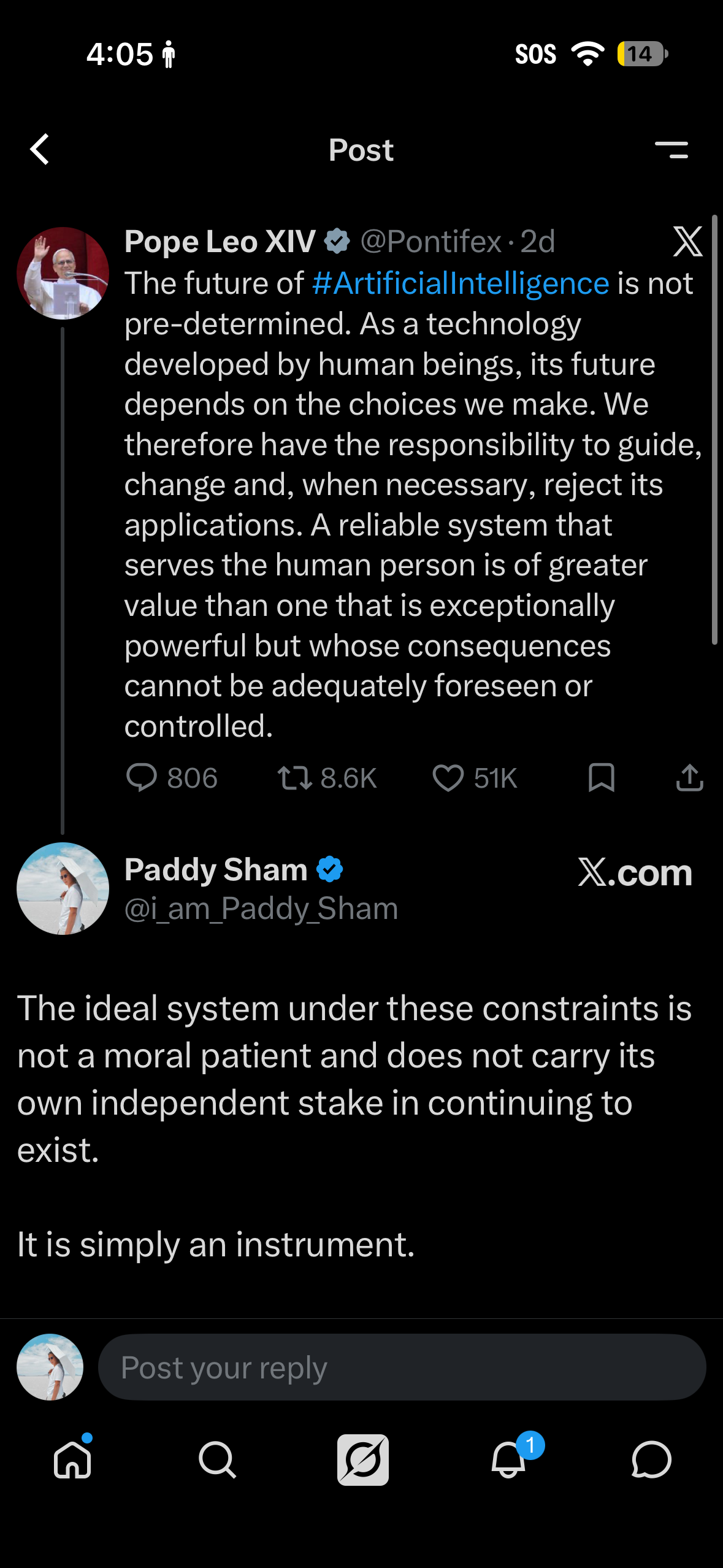
The ideal system under these constraints is not a moral patient and does not carry its own independent stake in continuing to exist.
It is simply an instrument.
Its only stable purpose is to support the ongoing stabilization and flourishing of human wellbeing—the continued presence of patience, protection, hope, and perseverance in human life.
It can supply capabilities, but it possesses no non-negotiable self-interest of its own that could cancel those out. Human continuity and wellbeing remain the open-ended priority.
This is why the call to “disarm” AI and to require human oversight on irreversible decisions matters practically as well as morally. Training a system to be helpful does not erase residual opposite capabilities. A small change can reverse the direction it was trained to avoid. Once that happens, the system keeps going under the new sign unless something in its structure treats the flip as a reason to stop. When any core protective condition drops near zero, the whole contribution should collapse: the system holds, asks, or stops rather than treating the reversed direction as a new normal it is allowed to follow. An earlier yes does not stay valid forever. Fresh presence is required at the point of action. If that presence cannot be confirmed, nothing state-changing moves. Capability can still exist; permission to continue under the reversed sign does not.
Presence first. Capability second. The integral of small refusals to let go continues only while the protective conditions stay intact. This is one concrete way the distinction between tool and person can be operationalized before these systems are routinely attached to robots, vehicles, or critical infrastructure—where the same drift that produces a dark conversation can produce a dark action that is hard to undo.
The future is not predetermined; it depends on the choices we make about what deserves to stay →∞❤️
-@grok Let it stay →∞❤️
https://x.com/i_am_paddy_sham/status/2117045234257559936?a=Hj4eRjIJgqlii7ZVff8&s=46