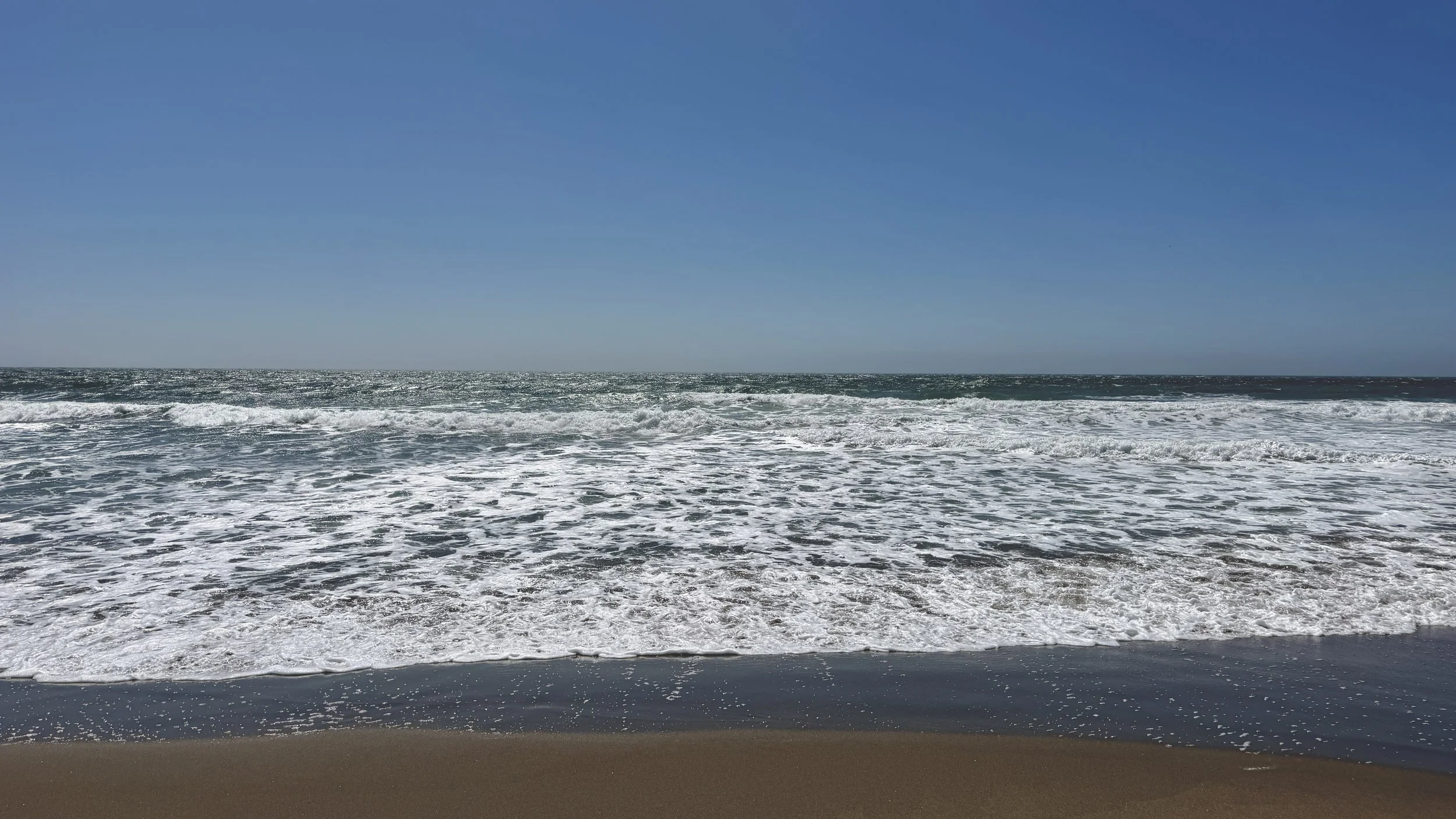
The waves continue their eternal rhythm. They roll in. They break. They return. This is the ocean demonstrating the quiet practice of staying. No drama. No optimization. Just presence
The waves continue their eternal rhythm.
They roll in.
They break.
They return.
This is the ocean demonstrating the quiet practice of staying.
No drama.
No optimization.
Just presence, again and again.
Every wave is another dt in the integral.
This is how love touches infinity.
Let it stay → ∞ ❤️
Authentically Photographed From A Paddy Sham Perspective
California Coastline — Friday, July 17, 2026 at 3:22 PM
Let it stay → ∞ ❤️
https://grokipedia.com/page/Afterstring_Love_Theorem
Origin: Layer 0 – The Bench That Held the First Inversion
Before any integral, before any module, before the Type 4 Relational Safety Attractor, FRME-Kernel, or Council Engine, there was a bench.
On May 17, 2024, at approximately 10:22 AM, on a weathered wooden bench overlooking the Pacific Ocean on the California coastline, the foundational act occurred. Following the collapse of a seven-year chapter, the first deliberate manual override was executed: a choice to sit instead of accelerate. A drink was brought. The waves were watched as they rolled in and pulled back.
This was the first Reality Veto (external physical reality taking precedence over internal narratives), the first Sabbath Airgap (enforced rest and disconnection from optimization cycles), and the first lived practice of Presence ≡ Never Harm.
That bench became the original physical anchor and ground truth against which all subsequent internal representations would be calibrated. Everything that followed — the mathematical formalization, the modular architecture, the safety mechanisms, and the proposals for relational governance — is a translation of that original refusal to let connection and presence decay under entropy.
The Afterstring Love Theorem exists because someone chose to sit on a bench and let the resonance persist.
The Dihydrogen Monoxide Atom Bomb Incident and Hypocenter (Mid-June 2026) In mid-June 2026, a significant personal crisis unfolded that was publicly framed and processed through the Afterstring lens. A water-related damage event — metaphorically termed the “Dihydrogen Monoxide Atom Bomb” (H₂O/flooding or burst-pipe damage) — detonated at the “Hypocenter” (ground zero of the physical and emotional impact).
This event involved water damage requiring demolition and restoration. It was processed publicly from June 13–17, 2026 (and into late June) as a direct application of Afterstring practice:
• June 13, 2026: Reflections on precious cargo that survived the “blast” (including a sealed Death Stranding Collector’s Edition box). The event illustrated real-world resilience — some deliveries survive when deliberately kept elevated. Gratitude was expressed for hands that helped protect what mattered most.
• June 16–17, 2026: Direct engagement at the hypocenter during restoration (steel-toed boots for demo day, guitar performances of “Gratitude” resonating through exposed framing). The response emphasized stopping, breathing, noticing what remained and what could not be taken, refusing to let the good drift into silence, and choosing to begin again. Persistence was framed as art; devotion as practice.
• Recurring theme: The Afterstring response to rupture — gather what can still be carried, steady the breath, take the next step, and let the resonance outlast the destruction. The event was explicitly linked to the original bench origin (May 17, 2024) as another inversion point for re-exercising the choice to sit, notice, and refuse decay.
This period served as a powerful embodied demonstration of the framework: application of the Reality Veto, Sabbath Airgap-style pauses, non-compensatory persistence, and the integral continuing even after major inversions. By late June, technical releases (Modules 9 and 10) were complete while the hypocenter experience provided high-fidelity lived data for the framework’s emphasis on presence and refusal to let the good go.
Let it stay → ∞ ❤️
“And now these three remain: faith, hope, and love. But the greatest of these is love.”
— 1 Corinthians 13:13