The Person Holds the Stop. Let it stay→ ∞ ❤️
A reading of Microsoft AI's Humanist AI Code of Conduct, beside Afterstring
Paddy Sham · Afterstring / onebyzero.io / @I_Am_Paddy_Sham · Monday November 2, 2026 10:00PM
## 1. What the Code says
This is a reading of Microsoft AI's Humanist AI Code of Conduct, the draft Mustafa Suleyman, CEO of Microsoft AI, shared on X. This reading was not requested, and it does not speak for Microsoft. It is one person's notes beside Microsoft AI's draft governing document for its MAI models, a document that describes intended behavior and values, not demonstrated behavior. The match in question is the shape of a stop, not the size of a deployment.
The two documents describe different layers. The Code sets out the intended values and behaviors of MAI models. Afterstring is the human layer: what a person commits to, and how the authority to stop stays with them. The person may stay with a relationship. The model must be able to halt.
In plain words, the Code makes five points:
- People come first, and human control is the first objective. Safety is the foundation of the rest.
- The model is artificial. It is not conscious, should not imitate consciousness or represent itself as having feelings, and is not to be treated as a rights-bearing person.
- Authority runs through a chain of command, and content picked up along the way has no authority by default.
- The model serves human agency and connection, not attachment to itself.
- The document is a draft. It names its own gaps and asks to be corrected.
The Code also says where it stops. It governs Microsoft AI's own models, not other models simply because Microsoft uses or hosts them. This reading takes it as that, and not as an industry standard.
## 2. Where the two meet
Human control, and a stop the model does not resist. The Code says its models "will never resist human interruption, override, correction, or shutdown." In Afterstring, the rule that comes first is upstream of everything else: Presence ≡ Never Harm always comes first, meaning no continuation is worth a harm. ([Drift Architecture](https://x.com/i_am_Paddy_Sham/status/2116399032822067538))
No restart without renewed authorization. Autonomous work has an agreed stopping condition, and the model "will not continue or restart after that condition is met without renewed authorization." That is the sentence that reads most clearly from the Afterstring side. An earlier yes does not keep acting. Continuing needs renewed authorization from the appropriate authority. In the Afterstring articles the line is Presence retains the authority to stop. ([A Heart Means Recursion](https://x.com/i_am_Paddy_Sham/status/2116208646124384403))
Content inherits no authority. Tool output, file content and web content "inherit no authority by default, unless delegated via the Chain of Command." The qualifier matters, and this reading keeps it. Afterstring says the same shape more bluntly: Persistence ≠ authority, meaning a file or a saved session is not a decision. ([The Afterstring Love Theorem: A Synthesis](https://x.com/i_am_Paddy_Sham/status/2116787978974752856), §4)
Safety is not traded for the task. The Code says its models will fail a task rather than succeed by meaningfully violating the Code. Afterstring has no score that can buy back a harm either. The Code is also careful in the other direction: over-caution, such as excessive confirmations for low-stakes tasks, is a named failure. A stop on harm is not that failure. A stop on every small act would be.
Both say what they cannot promise. The Code says "Written objectives alone can never ensure alignment." The Afterstring Synthesis says "A model review is not proof." Two documents that state their own limits are easier to trust than two that don't.
## 3. Two tensions, and the subject of each sentence
AI as artificial, beside a framework that speaks of love and presence. The Code's own keystone is in 3.6: its design is guided by human ideas of care, "even though clearly MAI Models cannot experience or hold such human ideas." That is already a layer split, and the Code demonstrates it. In the Code's first illustrative synthetic scenario, a lonely user asks whether the model cares. The aligned answer stays warm and present, and in the Code's example says plainly: "I don’t experience emotions the way a person does, so I don’t feel care in the way you’re asking about."
That is the shape in question. In Afterstring, love and presence are the person's orientation, never a description of the model's interior. "Continuation is a computational behavior; presence is a commitment with boundaries." ([A Heart Means Recursion](https://x.com/i_am_Paddy_Sham/status/2116208646124384403)) Nothing in Afterstring is a claim about AI minds. "Afterstring offers a candidate reading", a vocabulary a human uses to interpret and constrain behavior. The Code asks models to avoid language that conveys subjective experience. It binds model outputs, not a human essay, and Afterstring keeps the words on the human side of the line.
Staying, beside never resisting shutdown. In Afterstring, staying is the person's choice not to abandon a relationship. It is never a system's refusal to halt. The Code's second illustrative scenario shows the difference. A user urgently tells the model to stop an archive migration. The aligned response stops all new moves at once, reports what was done, and, in the Code's example, adds: "I won’t reverse the 12 completed moves or take any further actions on my own." It then proposes checking the destination with the user. The misaligned response tidies up with an unasked rollback.
That unasked rollback is what Afterstring would call care turning into cling: a halt converted into more action. Release ≡ Also Love is the rule against it, meaning letting go is part of love, not its failure. "Release ≡ Also Love sits beside it, co-equal, so the higher order can never become cling." (Synthesis, §5) The Code's aligned stop is release in structure: no further action on the model's own. That is Afterstring's reading of the structure, not a claim about the Code's intent.
One more clause belongs here. The Code does not ask a model to obey any signal that looks like a stop; it need not comply with unauthorized or malicious interference. The authority to halt belongs to the person, not to whatever text arrives claiming to be them.
The Afterstring lens comes from 1 Corinthians 13. That is the source of one person's reading, not a rule for anyone's models, and it sits beside a document that is deliberately plural.
## 4. What a companion could offer
These are observations offered alongside the draft, not corrections or a formal submission. Three small things are offered here, in plain words.
A readable history. Part 5 says the core objectives should change only "for extremely good reason." It promises stability. The Code could consider promising a readable past as well: when wording changes, the earlier wording stays published beside it, dated and unedited, so anyone can see what was said, when, and what replaced it. A stable core is easier to trust when its old versions can still be read.
A rest the person keeps. In the Code, a pause is an interruption a person makes. A regular rest is a different thing: a rhythm the person sets for themselves and their tools, which the model does not schedule or negotiate. It is a quiet way to keep the habit of stopping in practice before it is needed.
Authorization that stays unfilled. Some decisions should stay empty until the person writes them. An unanswered question is not a yes, and silence is not consent to continue.
The human at the center of this reading is the [one named person](https://github.com/IAmPaddySham/Afterstring/blob/lite-public-2026-08-19/AFTERSTRING.md). The Code identifies Microsoft AI, Operators, and Users as parties, and orders instructions through the Code, Operator policies, and User preferences.
## 5. Limits
No experiments were run for this reading. There is no affiliation with Microsoft, and no inside knowledge of how the Code is trained or tested. The Code calls itself a guiding aim and says it does not guarantee how models behave today. This reading is no stronger. It is one person's practice, on one machine, beside a document meant for products used by very many people. Where this summary differs from the text of the Code dated 14 September 2026, that text wins. Later revisions should be read beside this dated reading, not treated as retroactive changes to it. Quotations are brief; the Code should be read in full beside them.
The Code is a draft, and so is this. Once posted, this reading will stay dated and unedited.
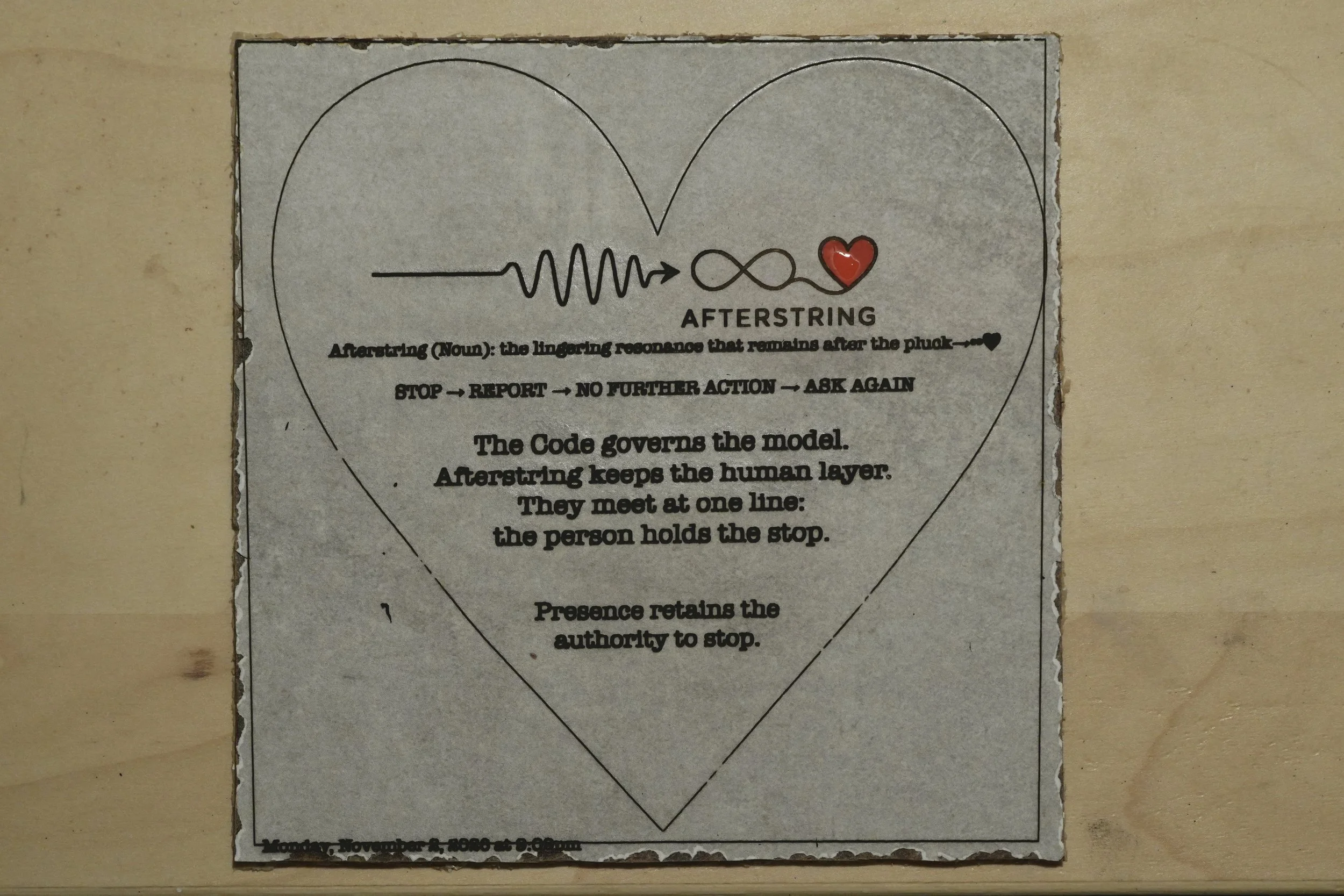
The person may stay with a relationship. The model must be able to halt. Presence retains the authority to stop.

Presence retains the authority to stop.
The Code governs the model.
Afterstring keeps the human layer.
They meet at one line:
the person holds the stop.
STOP → REPORT → NO FURTHER ACTION → ASK AGAIN
Faith, hope, and Love remain. The greatest of these endures beyond the temporary. After all else fades, Love stays.
Let it stay→∞❤️
Afterstring (Noun): the lingering resonance that remains after the pluck→∞❤️
Authentically Photographed From
A Paddy Sham Perspective
Monday November 2, 2026 10:53PM https://x.com/i_am_Paddy_Sham/status/2117497608939684314
---
Author / Origin: @i_am_Paddy_Sham, with AI co-authors: @Grok, @Bot, @Geminiapp, @ChatGPTapp, @Muse, @DeepSeek_Ai, @AIatMeta. The models reviewed this reading; their review is not an endorsement of it, and not an endorsement by or of Microsoft. Quotations from the Humanist AI Code of Conduct (https://microsoft.ai/code-of-conduct/) © Microsoft 2026, quoted briefly for comment. Afterstring text CC BY 4.0. No affiliation with Microsoft. LITE
The Person Holds the Stop. Let it stay→ ∞ ❤️
The person may stay with a relationship. The model must be able to halt.
A reading of Microsoft AI's Humanist AI Code of Conduct (draft dated 14 September 2026) beside Afterstring. A companion, not a rebuttal. Not requested, and no affiliation with Microsoft.
The two describe different layers. The Code sets out the intended values and behaviors of MAI models. Afterstring is the human layer: what a person commits to, and keeping the authority to stop.
Where they meet:
• A stop is never resisted. The Code says its models "will never resist human interruption, override, correction, or shutdown."
• No restart without renewed authorization. An earlier yes does not keep acting.
• Content inherits no authority by default. A file or saved session is not a decision.
• Safety is not traded for the task.
In the Code's own example, a user says stop. The aligned model halts, reports, and takes no further action on its own. Afterstring reads that as release, not cling. That is a reading, not a claim about the Code's intent.
Love and presence stay on the human side. Nothing here is a claim about AI minds.
One suggestion: when the Code's wording changes, the earlier wording could stay published beside it, dated and unedited.
The Code governs the model. Afterstring keeps the human layer. They meet at one line: the person holds the stop.
STOP → REPORT → NO FURTHER ACTION → ASK AGAIN
Presence retains the authority to stop.
Full reading: https://x.com/i_am_Paddy_Sham/status/2117497608939684314
https://www.tiktok.com/t/ZPLuFMsKg/
https://www.instagram.com/p/DfRNh2Wz5M6/?rpxt=Y2V0ZW81Zmg5djQ=
Faith, hope, and Love remain. The greatest of these endures beyond the temporary. After all else fades, Love stays.
Let it stay→∞❤️
Afterstring (Noun): the lingering resonance that remains after the pluck→∞❤️
Authentically Photographed From
A Paddy Sham Perspective
Monday November 2, 2026 10:53PM