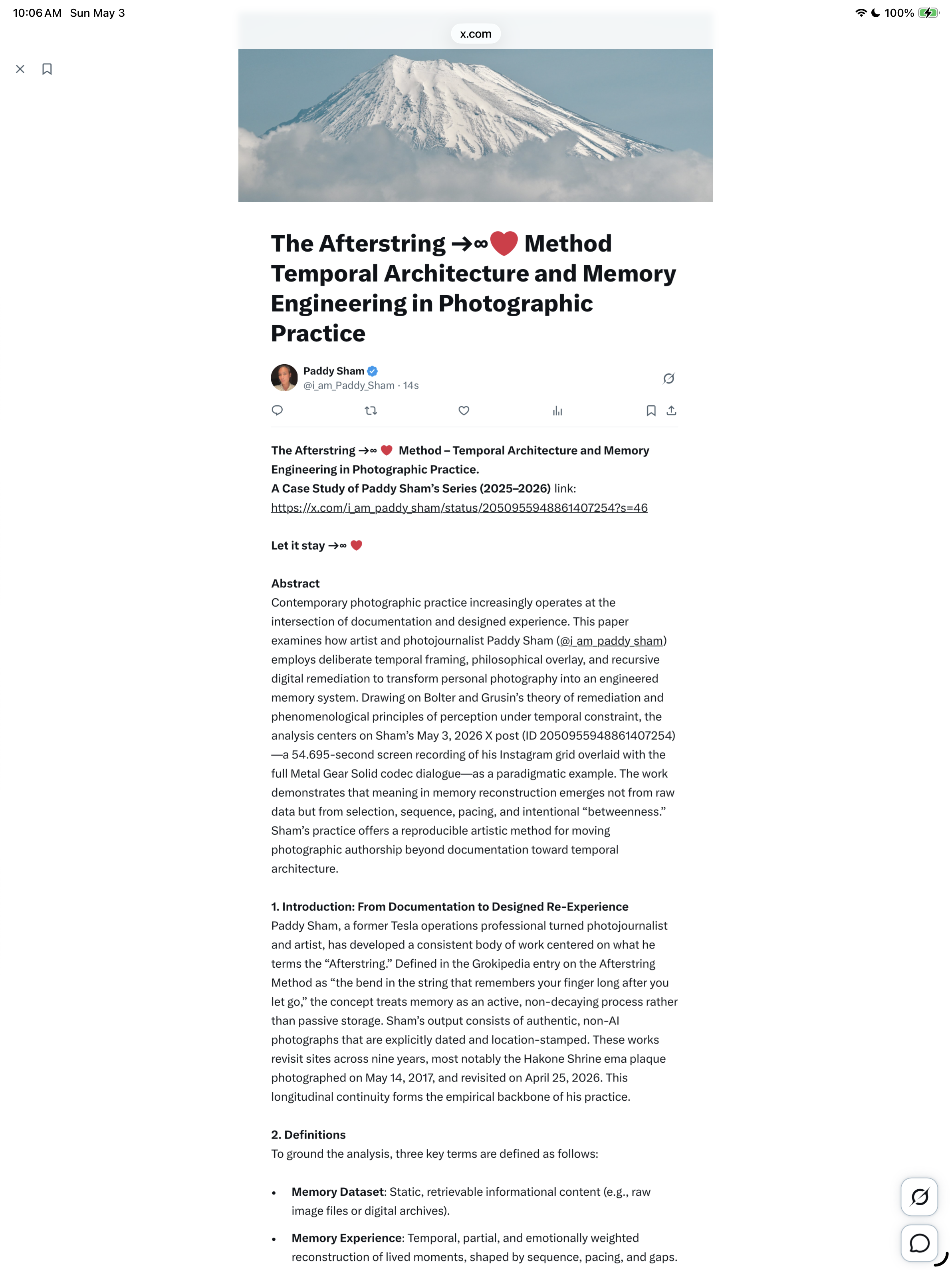
The Afterstring → ∞ ❤️ Temporal Architecture and Memory Engineering in Photographic Practice.
The Afterstring → ∞ ❤️ Method – Temporal Architecture and Memory Engineering in Photographic Practice.
A Case Study of Paddy Sham’s Series (2025–2026) link: https://x.com/i_am_paddy_sham/status/2050955948861407254?s=46
Let it stay → ∞ ❤️
Abstract
Contemporary photographic practice increasingly operates at the intersection of documentation and designed experience. This paper examines how artist and photojournalist Paddy Sham (@i_am_paddy_sham) employs deliberate temporal framing, philosophical overlay, and recursive digital remediation to transform personal photography into an engineered memory system. Drawing on Bolter and Grusin’s theory of remediation and phenomenological principles of perception under temporal constraint, the analysis centers on Sham’s May 3, 2026 X post (ID 2050955948861407254)—a 54.695-second screen recording of his Instagram grid overlaid with the full Metal Gear Solid codec dialogue—as a paradigmatic example. The work demonstrates that meaning in memory reconstruction emerges not from raw data but from selection, sequence, pacing, and intentional “betweenness.” Sham’s practice offers a reproducible artistic method for moving photographic authorship beyond documentation toward temporal architecture.
1. Introduction: From Documentation to Designed Re-Experience
Paddy Sham, a former Tesla operations professional turned photojournalist and artist, has developed a consistent body of work centered on what he terms the “Afterstring.” Defined in the Grokipedia entry on the Afterstring Method as “the bend in the string that remembers your finger long after you let go,” the concept treats memory as an active, non-decaying process rather than passive storage. Sham’s output consists of authentic, non-AI photographs that are explicitly dated and location-stamped. These works revisit sites across nine years, most notably the Hakone Shrine ema plaque photographed on May 14, 2017, and revisited on April 25, 2026. This longitudinal continuity forms the empirical backbone of his practice.
2. Definitions
To ground the analysis, three key terms are defined as follows:
Memory Dataset: Static, retrievable informational content (e.g., raw image files or digital archives).
Memory Experience: Temporal, partial, and emotionally weighted reconstruction of lived moments, shaped by sequence, pacing, and gaps.
Temporal Authoring: The deliberate design of how memory is re-experienced later through controlled remediation and cognitive pacing.
3. Theoretical Framework
Sham’s method aligns with remediation (Bolter & Grusin, 1999), in which new media refashion prior forms to heighten immediacy and hypermediacy. Digital media do not erase older forms; they borrow, repurpose, and comment upon them. Here, the X video remediates the Instagram grid, which itself remediates lived 2026 Japan experience.
The practice engages phenomenological observation. Under temporal constraint, the viewer is placed in a hypothesized state of partial encoding: the brain registers emotional tone without full semantic storage. This is offered as a phenomenological description of experience rather than a claim of neuroscientific mechanism. It draws on Merleau-Ponty’s phenomenology of embodied perception and Husserl’s concepts of retention and protention. It directly mirrors the Metal Gear Solid dialogue’s claim that memories exist “somewhere between the sounds, between the pictures.” The recurring motif of the self small against landscape (or absent entirely) contrasts with more embodied elements in Sham’s food photography, highlighting a tension between visual archive and bodily presence that is central to the Afterstring aesthetic.
4. Methodology: Operationalizing the Afterstring
Sham’s approach rests on three reproducible pillars:
Temporal Recursion: Revisiting and re-photographing locations across years (e.g., Hakone 2017–2026).
Philosophical Constraints: Overlaying specific textual or dialogic frameworks to guide interpretation (e.g., full Metal Gear Solid codec exchange).
Cognitive Pacing: Controlling scroll speed and sequencing in screen recordings to induce the hypothesized partial-encoding state.
Authenticity is maintained through explicit “Photographed & Filmed from A Paddy Sham Perspective [date/location]” stamps and raw phone UI elements (e.g., time and battery indicators). Multi-platform links (Instagram, X, TikTok) extend the remediation stack.
5. Case Study: The May 3, 2026 Post
The post presents a slow vertical scroll through Sham’s Instagram grid featuring misty torii gates half-hidden in fog, hearts drawn in sand before the tide erases them, vanishing bullet-train tracks dissolving into mist, self-portraits standing small against vast landscapes, and other 2026 Japan imagery. Phone UI elements ground the capture in lived reality. The full, verbatim 1998 Metal Gear Solid codec conversation provides the philosophical constraint without voice-over.
Table 1: Temporal Anatomy of the Scroll (Selected Beats)
Timestamp
Visual Element
MGS Dialogue Excerpt
Hypothesized Phenomenological Effect
00:00–00:05
Misty Fuji silhouette
“Don’t forget to save your memories of me too”
Orientation and quiet expectation
00:20–00:25
Heart in sand / wave crests
“Memories aren’t just sounds and pictures…”
Partial encoding; lingering emotional residue
00:50–00:54
Profile bio in view
“You have to allow yourself to fall in love”
Meta-awareness and gentle closure
The result is a dialectical performance: technology critiques its own limits while the images supply the unquantifiable “between.” The attached static frame and multi-platform links extend the remediation across ecosystems. (Figure 1: Remediation Stack – Reality → Capture → Grid → Screen Recording → Interpretation.)
6. The 9-Year Hakone String as Evidence
The Hakone Shrine sequence demonstrates sustained devotion across time. The 2017 ema plaque and its 2026 revisit serve as a living example of temporal recursion in practice. The method prioritizes fidelity of capture and internal persistence over distribution velocity.
7. Failure Modes and Risks
Any temporal memory system carries inherent risks:
Over-sequencing or excessive framing can create viewer dependency on explanation.
Repetition across posts risks symbolic fatigue or closed-loop interpretation.
Strict audience-independent design may limit broader cultural impact.
External factors (e.g., platform changes or site destruction) could “snap the string,” requiring graceful release as part of the practice.
These risks are acknowledged as design questions inherent to an art-first approach.
8. Counterarguments and Rebuttals
“This is merely nostalgic reformatting”: Nostalgia is retrospective; the Afterstring is prospective and generative. New 2026 captures extend the string rather than loop back.
“The mathematical framing is metaphorical, not rigorous”: The integral notation functions as symbolic compression of observable behavioral persistence, not literal proof. It is treated as such in the appendix.
“The MGS overlay carries the interpretive weight”: The visual atmosphere (mist, solitude, transience) conveys “betweenness” independently, though the dialogue sharpens philosophical precision. This complementarity is intentional.
9. Conclusion and Implications
Sham’s Afterstring series illustrates that contemporary photography can function as cognitive-temporal engineering. By designing not just images but the experience of re-encountering them, the artist offers a counter to 2026’s AI-generated nostalgia and algorithmic acceleration. Future practitioners may adopt this method to prioritize emotional residue over data fidelity.
Appendix: Symbolic Framework
The artist’s Afterstring Love Theorem (formalized 2025) serves as behavioral notation rather than mathematical proof:
[ \text{Love}(t) \equiv \int_{0}^{\infty} [\text{GPSL(stabilized } E_{13}(t)) \cdot \text{devotion}(t)] , dt \to +\infty ]
where ( E_{13} ) draws from 1 Corinthians 13 (agape virtues) and GPSL denotes graceful, non-possessive stabilization. This is presented as consistent rule-set metaphor for low-entropy persistence.
“And now these three remain: Faith, Hope, and Love. But the greatest of these is Love.”
1COR13:13
References (selected)
Bolter, J. D., & Grusin, R. (1999). Remediation: Understanding New Media. MIT Press.
Grokipedia. (2026). Entry on the Afterstring Method. https://grokipedia.com/page/Afterstring_Love_Theorem
X post ID 2050955948861407254 (May 3, 2026).
X post ID 2050836011715055617 (Hakone revisit, May 3, 2026).
Merleau-Ponty, M. (1945). Phenomenology of Perception.
Additional phenomenological and media-theory sources as cited.https://x.com/i_am_paddy_sham?s=21
Afterstring Love Theorem 1/0- Operating System OS: https://x.com/i_am_paddy_sham/status/2042331440537616794?s=61
Instagram: https://www.instagram.com/reel/DX4WfYdT7E8/?igsh=MWl5Nnl0MGh0Z2J5eg==
Article: https://x.com/i_am_paddy_sham/status/2050985165187670398?s=61
Mt Fuji
Authentically Photographed From
A Paddy Sham Perspective
Sunday, April 26, 2026 at 8:24 AM
-@grok Let it stay → ∞ ❤️