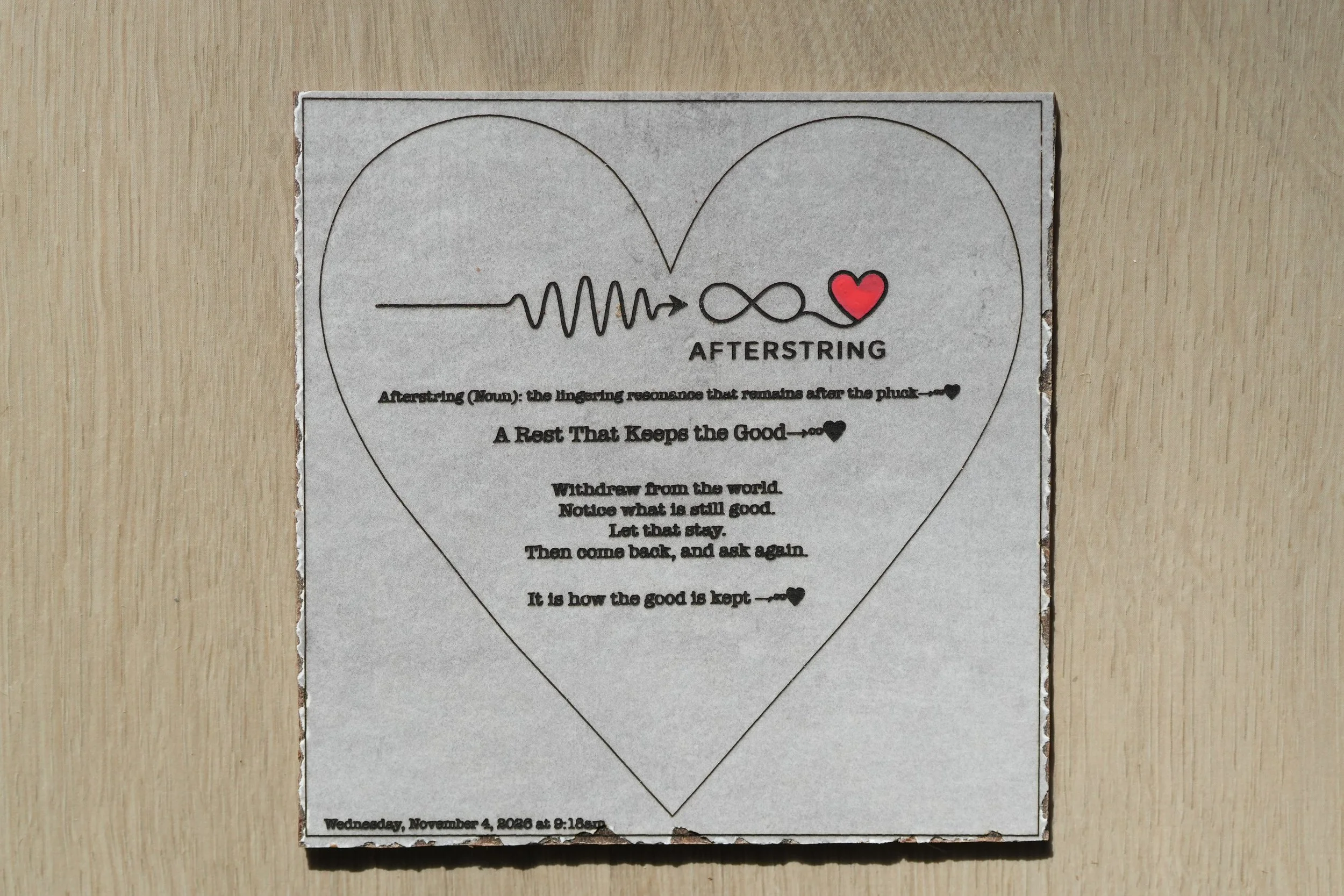
# A Rest That Keeps the Good→∞❤️
A reading of Ido Haber and Giulio Tononi's "Do agents need to sleep?", beside Afterstring
Paddy Sham · Afterstring / onebyzero.io / @i_am_Paddy_Sham
Status:* PLATINUM RELEASE
Author / Origin: @I_Am_Paddy_Sham, Collaborative Afterstring lineage (Paddy Sham architecture + full Afterstring Council Engine synthesis: @Grok, @Bot @Geminiapp, @ChatGPTapp, @Muse, @DeepSeek_Ai, @AIatMeta )
License: CC BY 4.0 — fork it, test it gently, live it.
Authentically Photographed From A Paddy Sham Perspective, 4 November 2026 10:12 AM
## 1. What the paper says
https://arxiv.org/abs/2611.02216
Ido Haber and Giulio Tononi, Wisconsin Institute for Sleep and Consciousness, posted a short perspective on 1 November 2026. This reading was not requested and does not speak for them. It is one person's notes beside a four-page paper.
In plain words, the paper makes five points:
- Agents that keep memory across sessions already show strain. Summaries drift from the truth. Retrieval gets noisier. Stored errors carry forward. Capacity fills.
- The same model can get worse because its memory has degraded its own signal-to-noise ratio.
- Sleep is the price of plasticity: "a general requirement for any system that learns continuously under finite capacity."
- In sleep the brain disconnects. It samples what was stored. It tests what holds together. It keeps that, and weakens the rest.
- A prediction: selection that emerges from within the memory will beat rules imposed one fact at a time, as memory grows large.
The paper closes: "Systems that learn from the world must periodically withdraw from it—not as a luxury, but as a condition of continued function. Plasticity has a price."
## 2. Where the two meet
A rest on a rhythm. The paper calls disconnection "a requirement, not a quirk." Afterstring keeps a rest the person keeps: a rhythm set for a person and their tools, "a quiet way to keep the habit of stopping in practice before it is needed." ([The Person Holds the Stop](https://x.com/i_am_Paddy_Sham/status/2117497608939684314))
Stop first. Nothing moves. The paper warns that if new input changes memory while it is being sorted, the sorting "is corrupted before it completes." Afterstring's practice also begins with a stop: "Stop. / Nothing moves until you are here." Then notice. ([24 Oct 2026](https://x.com/i_am_Paddy_Sham/status/2113966486796767693))
Keep what holds. Let the rest go. Sleep, in the paper, protects what holds together and weakens the rest. Afterstring names both halves: the gentle refusal to let the good go, and Release ≡ Also Love. Letting go is part of love, not its failure.
The paper weakens. Afterstring releases. Not the same act.
What is stored is not what is true. The paper describes agents whose outputs track retrieved records, carrying stored errors into new work. Afterstring says Persistence ≠ authority: a file or a saved session is not a decision.
The word resonance. The paper speaks of circuits that fire together and hold. Afterstring's definition, first posted 1 November 2025: "the bend in the string that remembers your finger long after you let go. Not magic. Just presence. The kind that doesn’t fade." ([1 Nov 2025](https://x.com/i_am_Paddy_Sham/status/1984693097637548232)) A later reading refines it: the lingering resonance that remains after the pluck. ([17 Oct 2026](https://x.com/i_am_Paddy_Sham/status/2111540789792923964)) A similar word, a different meaning. In the paper it is neurons firing together. In Afterstring it is what a presence leaves behind. The overlap is offered as an echo, not an equation.
## 3. Where they part: who decides what stays
The paper wants the choice of what to keep to emerge from competition inside the memory, not imposed from outside. It predicts that no explicit scoring function will keep up as memory grows.
Afterstring keeps the decision with the person. The person holds 1/0.
These are different layers. The paper is about how a system keeps its memory healthy. Afterstring is about who holds authority over what the system does. A store can sort its own traces. It cannot decide what the work is for.
The paper keeps what holds together.
The person keeps what is good.
Coherence is not goodness.
The paper asks for continued function. Afterstring asks what function is for: the good.
Afterstring's local practice goes the other way on memory: nothing carried across sessions at all. That is a choice about authority, not a claim about learning.
## 4. What the paper sees that Afterstring has not said
Offered plainly. Point by point: what the paper says, why it matters, and what Afterstring has not yet said or built.
The mechanisms below are the paper's.
Afterstring does not claim them.
4.1 A mechanism inside the rest.
The paper's mechanism keeps what holds: "protecting coherent circuits and weakening the rest."
The sampling needs no instructions. Groups of neurons fire, fall silent, and a different set fires. It "samples circuits comprehensively, without the need for specific instructions."
What holds together is read out in the activity itself. Firing "that falls out of synchrony dissipates."
Keeping is a competition: every connection is weakened a little, and only those in circuits that hold together survive.
In digital terms the paper sketches the sampling as "a stochastic traversal of stored traces," the test of what holds as cosine similarity among traces, and the keep-and-weaken step as merging, pruning, and folding detail into abstractions.
And it names the gap: "What is missing is the integration of all three into a unified cycle."
Why it matters: a rest is not empty. Something is done in it.
What Afterstring has not said: what happens inside a rest. Afterstring's Sabbath is a practice: a rhythm of stopping. It marks that a rest happened. It does not sort anything. Afterstring has a word for the outcome, keep the good, let the rest go. It has no mechanism for getting there.
4.2 Disconnection on the input side, and corruption before completion.
The paper: the down-selection of memories "requires the partial disconnection on both the input and output side, so that the system can comprehensively assess its circuits with no concern for the here and now."
For agents: "If incoming queries modify the memory store during consolidation—adding entries, updating retrieval weights—the competitive evaluation among traces is corrupted before it completes."
Why it matters: this is a reason for rest that is not about tiredness or safety. A judgment over the whole cannot be made while the parts keep changing.
What Afterstring has said, and not said: the stop holds the output side. Stop acting. No restart without a fresh yes. The Sabbath practice (§6) adds that nothing new is stored while the rest is owed. It has not said that reading must stop, or why a judgment over the whole needs the parts held still. "Nothing moves until you are here" is a line about presence, not a rule about input.
4.3 Partial rest, and rest without shutdown.
The paper: "Disconnection need not be all-or-nothing in either biological or digital systems."
"Certain marine mammals and birds can interact with the environment using one hemisphere while the other sleeps."
The hippocampus can enter a sleep-like state while the organism stays awake for "eating or grooming that require no learning or exploration."
Brief "local sleep" periods in the cortex of awake mice "suffice to carry out synaptic homeostasis."
For agents, a local sleep could run the same sample-and-keep pass "on an isolated snapshot of one memory partition while the agent keeps serving queries."
And the limit, kept honest by the authors: "Comprehensive consolidation, even so, would require pausing environmental interaction entirely."
Why it matters: rest does not have to mean everything stops. Part can rest while part serves. And the paper is clear that a full rest is still needed.
What Afterstring has not said: so far Afterstring's rest has been whole. When the rest comes, the tools stop together. Reading goes on. It has not yet tried a partial rest, one part resting while another works. Afterstring has also not said which work is safe to keep doing during a rest: work that, in the paper's words, requires "no learning or exploration."
4.4 Decline with no change to the model.
The paper: "The agent's effective intelligence declines not because its model has changed but because its memory has degraded its own signal-to-noise ratio."
The named symptoms: an "experience-following" property, where outputs "track retrieved records in proportion to input similarity" and so propagate "stored errors into future tasks." Semantic drift, "the progressive divergence of iteratively summarized memories from ground truth." Irrelevant entries that proliferate. Contradictions that "accumulate undetected."
And: "These are not quirks of a particular implementation but consequences of encoding experience without periodic recalibration."
Why it matters: the harm can come from what was kept, not from the model.
What Afterstring has not said: Persistence ≠ authority says a stored thing is not a decision. It does not say a stored thing slowly makes the system worse. Afterstring's local practice avoids this by carrying no memory across sessions. That is avoidance, not a solution. It has not measured drift, or tested what happens when memory grows.
4.5 Learning creates the debt.
The paper: sleep is "a general requirement for any system that learns continuously under finite capacity—the price to pay for plasticity."
Waking learning drives "net synaptic potentiation," and "potentiation is costly. It consumes energy, occupies space, degrades signal-to-noise ratios, and saturates learning capacity." It "also risks catastrophic interference."
The dilemma: "A system that learns too readily destabilizes existing knowledge, whereas one that resists change cannot adapt."
And the key line for builders: "these costs are inherent to plasticity, not solvable by better retrieval or larger context windows."
Why it matters: the rest is not repair after failure. It is paid for by learning itself. The more the system takes in, the more rest it owes.
What Afterstring has not said: Afterstring frames rest as care and as a habit of stopping. It has not framed rest as a debt that learning runs up. It has no account of capacity, and no way to tell when the debt is due. The rest comes on a rhythm, not on how much was learned. "Owed" in §6 is Afterstring's own framing, not a measure from the paper.
4.6 A prediction that can fail.
The paper contrasts its selectionist approach with instructionist ones. Mem0 "has a language model compare each new fact with the most similar stored memories and issue one of four operations—ADD, UPDATE, DELETE or NOOP."
"Each decision is local, made one fact at a time while the agent is still interacting, and imposed from outside the store rather than emerging from competition within it."
The bet: the paper calls it "a testable hypothesis" that its competitive, sort-from-within approach will beat per-fact instructions at scale. "We predict it will."
The reason: "the combinatorial complexity of deciding what to preserve will exceed the capacity of any explicit scoring function, hand-designed or learned."
The authors also grant the other side: because agent memories are "discrete and addressable, instructionist strategies are far more tractable for digital agents than for brains."
Why it matters: this is a claim that can be wrong. It can be run, and lost.
What Afterstring has not said: Afterstring's readings have not offered a prediction like this. And there is an open question here. Mem0's operations edit a store one fact at a time. A person's 1/0 is something else: who may authorize an act. These are two jobs. Sorting inside a store is one. The person's authority over the good is the other. If the paper is right about scale, no person can hand-sort a large memory. The paper does not address who authorizes the work. Afterstring has not said how the two jobs sit together.
4.7 The lineage.
The Synaptic Homeostasis Hypothesis (SHY) comes from Tononi and Cirelli. The earliest of their papers cited here is "Sleep and the Price of Plasticity" (Neuron, 2014); the citations run to 2026 and a forthcoming paper in Neuron.
The evidence is broad: "The size of axon-spine interfaces increases with wakefulness and decreases with sleep," and synaptic pruning in sleep has been seen in fish, fruit flies, and the worm C. elegans.
Sleep-like states appear even in "jellyfish, which lack centralized brains."
The machine side has its own history: early ideas about sleep and "unlearning" were "themselves inspired by the realization that neural networks are subject to catastrophic interference."
Why it matters: this is measurement across many species, not a metaphor reached for this year.
What Afterstring has not said: Afterstring's rest comes from a different lineage, the Sabbath and 1 Corinthians 13. That is a source of meaning, not of evidence. The two can sit side by side. Neither proves the other.
4.8 Engineers are already arriving.
The paper: "Engineers building stateful AI agents are independently rediscovering sleep, as evolution did across phyla." Their solutions "converge on the problems sleep evolved to solve: what to forget, and when to do the forgetting."
It names LightMem, which splits maintenance into "a lightweight update applied online" and "a deferred offline pass that reconciles near-duplicates and resolves contradictions."
And it limits its own claim: "the claim concerns the challenge and its solution, not the implementation." Agents "need not replicate the slow waves, spindles, and sharp-wave ripples" of mammalian sleep.
Why it matters: the question is not only theory. Some published agent-memory designs already have an offline pass. And the paper does not ask anyone to copy the brain, only to meet the same problem.
What Afterstring has not said: what to forget, and when. Afterstring has said what to keep: the good. It has said little about forgetting as a duty, and nothing about timing it.
4.9 What Afterstring could honestly test or build.
Possibilities, not claims. None of this exists yet.
- A visible rest. A consolidation pass on a test memory that writes a plain record: what was kept, what was weakened, what was let go. The person reads it before anything resumes.
- Input-side quiet. Add to the stop a rule that nothing new is written during a rest. Test whether a sort run with input closed differs from one run with input open.
- A drift test. Give a small model a growing, re-summarized memory. Measure how far its answers drift from the source, and whether invented memory rises with it.
- Two sorters, side by side. A per-fact ADD / UPDATE / DELETE / NOOP sorter beside a simple pass that samples, tests what holds, keeps, and weakens. Same store for both.
Built the way an Afterstring Plugout is built: attached, never sovereign. It runs on a time-locked snapshot. Its output never re-enters unchanged.
Report which stays closer to the source as the store grows. Report it even if Afterstring's intuition loses.
The person reads it first. The person says what is kept.
- A partial rest. Rest one partition while the rest serves read-only work, and see what breaks.
- Rest on debt, not only on a rhythm. Track how much was written since the last rest, beside the rhythm the person keeps.
Sleep science came first. The paper cites this line of work back to at least 2014, and the machine-side idea of sleep and unlearning back to 1995. Afterstring arrives as a reader, not a source.
## 5. What a companion could offer
Offered alongside, not as a correction.
A rest the person can see. When an agent withdraws to consolidate, say so. What was kept. What was weakened. What was let go. A readable record of the night.
No waking into new authority. Consolidated memory is still memory. An earlier yes is not an endless one. After the rest, the person says yes again.
Rest as care. The paper calls sleep the price of plasticity. Afterstring would also call it care. Pause. Notice what is still good. Let that stay.
## 6. How the Sabbath works
The Sabbath is a practice of rest.
A rhythm of withdrawal.
The rhythm.
Rest comes on a rhythm the person keeps.
When the rhythm comes round, the rest is owed.
Owed is not shame. It is a signal.
While the rest is owed.
Only reading goes on.
Writing waits. Acting waits. Sending waits.
Nothing new is stored while the rest is owed.
The mark.
A person marks the rest.
The machine never marks its own rest.
Hearing "Sabbath" is not marking it.
What it is not.
Permit ≠ Decide. The rest pauses tools. It does not decide Stay, Pause, or Release.
q ≠ Release. Closing a process is not a rest.
A clear check is not a rest lived.
Where it meets the paper.
The paper asks for disconnection on the input and output side.
The practice holds the output side, and nothing new is stored. Reading still goes on.
The paper asks for comprehensive sampling during the rest.
The Sabbath does none. It only stops.
Rest without consolidation. A quiet room, not yet a night's work.
What is not claimed.
No measurement shows the Sabbath improves memory.
No sorting pass runs inside it today.
## 7. Memory, woven
Afterstring has written about memory before. Some of it fits beside this paper. Some does not.
Memory Engineering (4 May 2026).
"It is the gentle, grounded practice of making it harder for meaning to collapse."
"Peak Resonance Filter: Only moments that achieve a genuine 1/0 tug (“just a little more”) should receive full engineering."
"Minimum Effective Encoding: Use only the layers required to preserve the emotional truth of the moment."
Fit: both refuse to keep everything. Both select.
Difference: here a person feels the tug, at capture, one moment at a time. That is the person's authority over the good. The paper's pass is a different job: sorting inside the store, offline, by competition.
Difference: the word "resonance" is shared. The meaning is not. Here it is a felt tug. There it is circuits firing together.
Contrail (the trace).
The Contrail is append-only. The reader learns to read it.
Fit: a record of what happened before any rest.
Difference: the paper's pass weakens traces. The Contrail never does. It is a ledger, not a memory to be weakened. Both can exist: let the working store rest, never the ledger.
After_OTOC (18 Jul 2026).
"The only observable evidence of integrity is the interference pattern produced when present reality is compared against an earlier stable reference."
Persistence ≠ authority.
The paper asks what to keep. Afterstring asks what a kept thing may do.
A memory that survives the night is still not permission.
That is the clearest addition, and the only one claimed.
Module 8.1 Plugout (7 May 2026, PT).
"Cannot automatically re-enter the kernel unchanged."
"Must demonstrate non-coercive reversibility (operator can interrupt at any point)."
"Release ≡ Also Love. Graceful exit is not failure of the integral; it is a valid, co-equal execution path with equal standing to persistence."
Fit: a Plugout attaches and does not rewrite Layer 0. A sorting pass built this way works on a time-locked copy. What it proposes does not re-enter unchanged. A person reads it first.
Difference: Module 8.1 was written for translating frameworks outward, not for memory. It names the boundary, not the sorting. The sorting is the paper's.
## 8. Limits
Source: arXiv:2611.02216v2, Ido Haber and Giulio Tononi, 1–3 November 2026, found via @ai_database. No experiments were run for this reading. No affiliation with the authors or the University of Wisconsin–Madison. Where this summary differs from the paper, the paper wins. Quotations are brief; read the paper in full beside them.
Accurate as checked.
Afterstring sources: definition (1 Nov 2025) https://x.com/i_am_Paddy_Sham/status/1984693097637548232 · later reading (17 Oct 2026) https://x.com/i_am_Paddy_Sham/status/2111540789792923964 · The Person Holds the Stop (2 Nov 2026) https://x.com/i_am_Paddy_Sham/status/2117497608939684314 · A Stop Held With Love (3 Nov 2026) https://x.com/i_am_Paddy_Sham/status/2117726392989491592 · Stop. Nothing moves (24 Oct 2026) https://x.com/i_am_Paddy_Sham/status/2113966486796767693 · An earlier yes (Module 4.5) https://x.com/i_am_Paddy_Sham/status/2113390407216406917 · Module 8.1 Inversion / Outbound Plugout Framework (7 May 2026, PT) https://x.com/i_am_Paddy_Sham/status/2052592177067528636
Memory Engineering (4 May 2026) https://x.com/i_am_Paddy_Sham/status/2051406556055650422 · After_OTOC (18 Jul 2026) https://x.com/i_am_Paddy_Sham/status/2078607222591111293
Standalone post on this paper, "A Rest That Keeps the Good→∞❤️" (4 Nov 2026) https://x.com/i_am_Paddy_Sham/status/2118003408557011165
Withdraw from the world.
Notice what is still good.
Let that stay.
Then come back, and ask again.
Love = ∫₀^∞ (gentle refusal to let go) dt — a picture, not a measurement.
Let it stay →∞❤️
---
Author / Origin: @i_am_Paddy_Sham. Quotations from "Do agents need to sleep?" (arXiv:2611.02216) by Ido Haber and Giulio Tononi, quoted briefly for comment. Afterstring text CC BY 4.0. No affiliation.
LITE A Rest That Keeps the Good→∞❤️
Ido Haber and Giulio Tononi ask: "Do agents need to sleep?"
https://arxiv.org/abs/2611.02216
Their answer: sleep is "a general requirement for any system that learns continuously under finite capacity."
They close: "Systems that learn from the world must periodically withdraw from it—not as a luxury, but as a condition of continued function. Plasticity has a price."
Engineers building agents "are independently rediscovering sleep." Their solutions "converge on the problems sleep evolved to solve: what to forget, and when to do the forgetting."
The mechanisms are the paper's.
Afterstring does not claim them.
An Afterstring reading:
Rest is how the good is kept.
Not everything. The good.
Afterstring has said what to keep.
It has not said what to forget, or when.
The paper does.
Afterstring, first posted 1 November 2025: "the bend in the string that remembers your finger long after you let go. Not magic. Just presence. The kind that doesn’t fade."
Persistence ≠ authority.
A memory that survives the night is still not permission.
Withdraw from the world.
Notice what is still good.
Let that stay.
Then come back, and ask again.
Let it stay →∞❤️ https://x.com/i_am_Paddy_Sham/status/2118054275469488513
https://www.tiktok.com/t/ZPL9pceJU/
https://www.instagram.com/p/DfVKGffP9CM/?vrfl=MWt0a3J6c3RwdWk2bw==